

TranWare AI Transportation Software brings scheduling, dispatching, route optimization, fleet management, vehicle tracking, billing, mobile applications, payment processing, and AI-powered transportation tools into one connected platform. TranWare is designed for NEMT providers, paratransit operators, public transportation agencies, microtransit services, and mixed-use fleets.
This guide explains how smart transportation software can support daily operations, from booking a trip and assigning a driver to optimizing routes, tracking vehicles, maintaining fleets, processing payments, and communicating with passengers. It also explains the key features to consider when selecting NEMT, paratransit, or fleet management technology.

What Is TranWare AI Transportation Software?
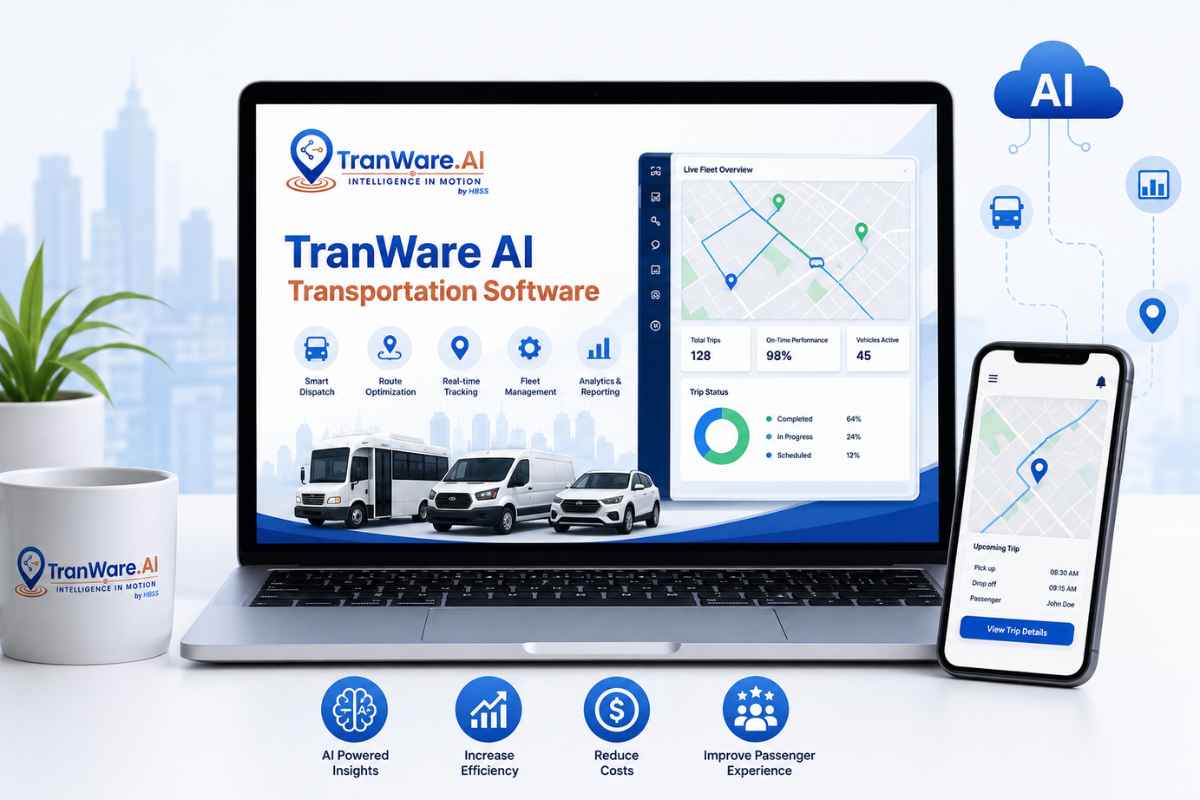
TranWare AI Transportation Software is built around a simple idea: transportation teams should not need disconnected tools for every part of their operation.
A modern transportation provider may need to receive a trip request, check passenger requirements, assign an appropriate vehicle, schedule a driver, optimize a route, monitor the trip, communicate with the passenger, record trip details, process billing, and maintain the vehicle. When these tasks are handled through separate systems, staff often spend time moving information between applications.
TranWare brings many of these operational functions together. Its platform supports reservation intake, scheduling, optimization, dispatching, GPS tracking, mobile applications, reconciliation, and billing.
The platform is positioned for several transportation markets, including:
- Non-Emergency Medical Transportation (NEMT)
- Paratransit
- Public transportation
- Microtransit
- Mixed-use fleets
TranWare states that its organization has more than 25 years of transportation industry experience, with 900+ operating sites performing more than 170,000 trips per day.
Why Smart Transportation Software Matters
Transportation operations become more complicated as trip volume, fleet size, service areas, and passenger requirements increase.
A small provider might manage trips using spreadsheets, phone calls, paper records, and separate GPS tools. This approach can become difficult to maintain as the organization grows.
A connected fleet management platform can give transportation teams a central place to coordinate daily operations.
Major benefits include:
- Faster scheduling
- More organized dispatching
- Better vehicle utilization
- More efficient routes
- Real-time fleet visibility
- Easier maintenance tracking
- Reduced administrative work
- Faster billing workflows
- Better passenger communication
- Centralized reporting
- Improved operational control
- Greater scalability
The value is not simply having more software features. The real value comes from connecting those features into a workflow that transportation staff can use every day.
Key Benefits of TranWare AI Transportation Software
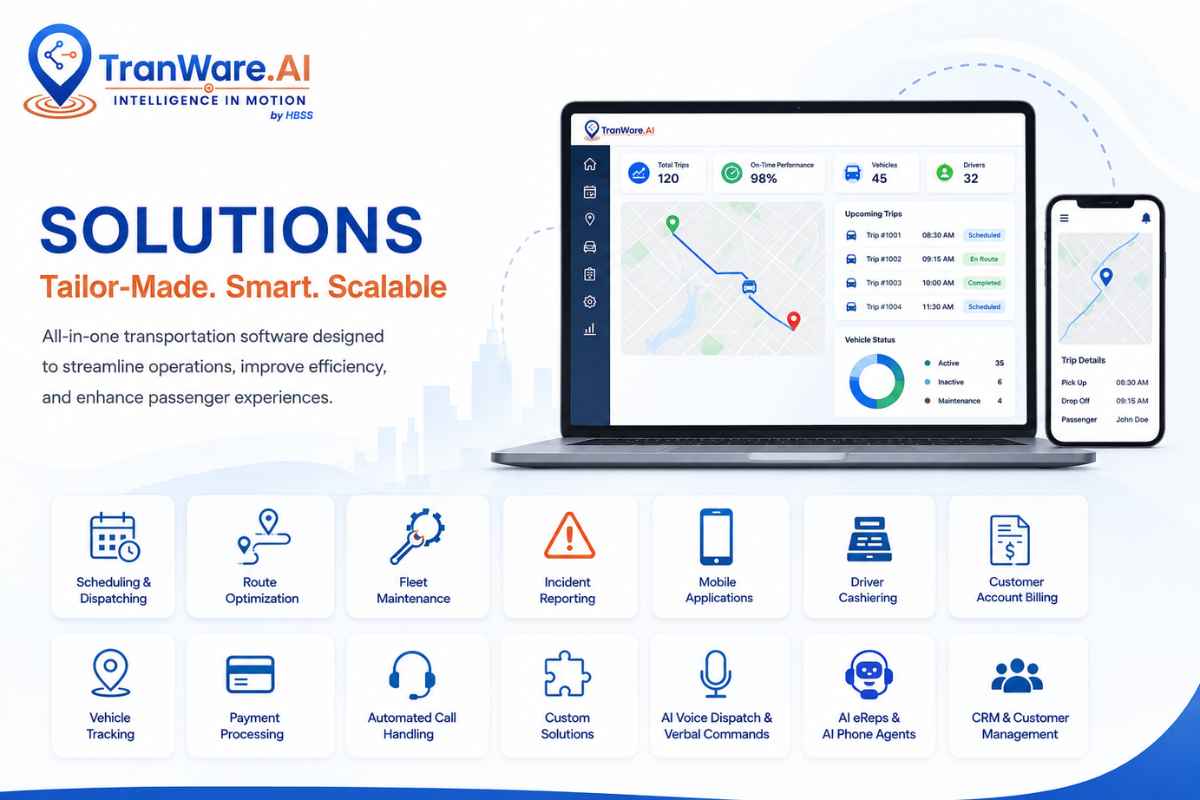
1. Centralized Transportation Management
Instead of managing scheduling, dispatching, fleet maintenance, billing, and tracking through unrelated systems, transportation providers can use an integrated management environment.
This can make it easier for managers to understand what is happening across the operation.
For example, a dispatcher may need to answer:
- Where is the assigned vehicle?
- Has the passenger been picked up?
- Is the driver running late?
- Which vehicles are available?
- Does the vehicle meet passenger requirements?
- What trips are scheduled next?
- Does the vehicle require maintenance?
Connected transportation software can make these answers easier to access.
2. Smarter NEMT Scheduling and Dispatching
NEMT operations have specific scheduling requirements. Trips may involve medical appointments, recurring rides, wheelchair-accessible vehicles, stretcher transportation, passenger mobility requirements, driver availability, and specific pickup windows.
NEMT scheduling software helps organize these requirements before a trip is dispatched.
Modern NEMT dispatch software can support:
- Trip reservations
- Recurring trips
- Driver assignment
- Vehicle assignment
- Trip status updates
- Dispatch changes
- GPS visibility
- Passenger information
- Trip history
- Reporting
TranWare’s transportation platform includes scheduling and dispatching capabilities designed to track trip progress, vehicle maintenance, and breakdowns in real time.
3. AI-Powered Dispatching and Voice Commands
One of the major differences between traditional transportation software and newer AI-enabled platforms is the ability to use artificial intelligence for operational tasks.
TranWare offers AI Voice Dispatch & Verbal Commands, allowing dispatchers and drivers to use voice commands for tasks such as scheduling trips, updating statuses, and managing operations hands-free.
This can be useful when staff need information quickly without navigating multiple screens.
Example
A dispatcher may need to update a trip status while handling another operational issue.
Instead of manually entering every update, a voice-enabled workflow can make certain actions faster.
AI should not replace human decision-making in every situation. Instead, it can reduce repetitive work and help transportation employees spend more time handling exceptions and customer needs.
4. AI eReps and AI Phone Agents
Telephone calls remain important in transportation, particularly for NEMT and paratransit providers.
Passengers, caregivers, healthcare organizations, drivers, and transportation coordinators may need to ask about:
- Trip bookings
- Pickup times
- Trip status
- Appointment information
- Cancellations
- Reminders
- General transportation questions
TranWare’s AI eReps and AI Phone Agents are designed to automate ride bookings, trip inquiries, reminders, and customer support through conversational interactions.
This can help transportation organizations handle repetitive calls while allowing staff to focus on complex requests.
5. Route Optimization Software
Route planning directly affects transportation costs and service quality.
Poor route planning can create unnecessary mileage, longer travel times, vehicle idle time, and missed scheduling windows.
Route Optimization Software for NEMT providers can consider factors such as:
- Pickup locations
- Drop-off locations
- Appointment times
- Driver availability
- Vehicle capacity
- Passenger requirements
- Multiple stops
- Traffic conditions
- Service areas
TranWare describes its route optimization capabilities as supporting both next-day batch scheduling and real-time multi-load route AI scheduling and optimization.
Example
Imagine a fleet has 50 scheduled trips and several passengers are traveling within the same geographic area.
Manual planning may assign trips based mainly on availability. An optimized system can consider multiple operational factors at the same time and help create more efficient routes.
The goal is not simply to create the shortest route. It is to create a route that meets transportation requirements while using vehicles and drivers efficiently.
6. Fleet Management and Maintenance
A transportation fleet depends on vehicle availability.
A vehicle that is unexpectedly unavailable can affect multiple scheduled trips. This is why fleet maintenance management systems are an important part of transportation operations.
Modern fleet management software can support:
- Preventive maintenance schedules
- Vehicle inspections
- Service history
- Repair records
- Maintenance reminders
- Vehicle availability
- Inventory management
- Driver inspections
- Maintenance reporting
TranWare includes fleet maintenance functionality for regular maintenance schedules, shift inspections, and inventory management.
Why Preventive Maintenance Matters
Preventive maintenance allows managers to schedule service before a small issue becomes a major operational problem.
For example:
Without structured maintenance tracking:
Vehicle issue → unexpected breakdown → vehicle unavailable → trip reassignment → dispatcher workload → passenger disruption
With structured maintenance tracking:
Maintenance reminder → scheduled service → vehicle availability planned → lower disruption risk
7. Digital Vehicle Inspections
Vehicle inspections are another important part of fleet operations.
TranWare’s Digital Vehicle Inspections use AI-assisted processes to help streamline inspections, identify maintenance issues earlier, and support fleet safety and reliability.
Digital inspections can help organizations move away from paper-based processes.
Inspection information can be used to support:
- Vehicle condition records
- Maintenance decisions
- Safety workflows
- Inspection history
- Operational reporting
This is particularly useful for organizations managing many vehicles across multiple locations.
8. Real-Time Vehicle Tracking
Vehicle tracking software gives transportation teams visibility into where vehicles are and how trips are progressing.
A fleet management vehicle tracking system can help monitor:
- Current vehicle location
- Driver status
- Trip progress
- Route adherence
- Delays
- Arrival estimates
- Vehicle utilization
TranWare provides real-time tracking of vehicle location and status as part of its transportation management capabilities.
Why GPS Tracking Matters
Consider a passenger calling because their vehicle has not arrived.
Without real-time tracking, staff may need to call the driver.
With GPS tracking, the dispatcher can check the vehicle’s current position and provide a more informed response.
That improves both operational visibility and customer communication.
9. Transportation Mobile Applications
Transportation operations do not happen only at a dispatcher’s desk.
Drivers spend most of their working time in vehicles. Passengers also need convenient ways to receive transportation information.
A Transportation Mobile App can connect drivers, dispatchers, and passengers.
Common mobile capabilities include:
Driver App
- Trip assignments
- Navigation
- Passenger information
- Status updates
- Trip completion
- Communication
- Digital records
Rider App
- Trip information
- Booking support
- Notifications
- Vehicle visibility
- Communication
TranWare’s platform includes mobile application capabilities for NEMT and paratransit fleets.
10. Incident Reporting Software
Transportation providers need a reliable way to document operational events.
Incident Reporting Software can support the recording and management of:
- Vehicle incidents
- Passenger complaints
- Accidents
- Driver reports
- Safety events
- Vehicle damage
- Operational issues
TranWare includes incident reporting for tracking events, complaints, and incidents with detailed logging and customizable fields.
A structured Transportation Incident Management Software workflow can make it easier for managers to review events and maintain consistent records.
11. Transportation Billing and Payment Processing
Transportation operations do not end when a trip is completed.
The completed trip may need to move into billing, reconciliation, payment, or accounting workflows.
NEMT billing software can support:
- Trip billing
- Invoicing
- Receivables
- Payment tracking
- Claim-related workflows
- Customer billing
- Driver reconciliation
TranWare connects customer account billing with driver cashiering and also provides credit-card payment processing capabilities.
This can reduce the need to manually transfer information between dispatch and financial systems.
12. Driver Cashiering and Reconciliation
For transportation providers that handle driver payments or cash transactions, Driver Cashiering Software can help organize financial workflows.
TranWare includes driver shifting and cashiering with automated voucher and credit-card reconciliation.
A transportation cashiering workflow may include:
- Driver shift begins
- Trips are assigned
- Payments or vouchers are recorded
- Driver shift ends
- Transactions are reconciled
- Financial records are updated
This creates a more structured connection between transportation operations and financial administration.
13. Automated Call Handling
Phone calls can consume a significant amount of staff time when the same questions are repeated throughout the day.
Transportation Call Management Software can support automated:
- Trip reminders
- Passenger notifications
- Callouts
- Appointment confirmations
- Trip inquiries
- Caller identification
TranWare’s platform includes integrated caller ID, passenger and trip search capabilities, callouts, and reminders.
Combined with AI phone agents, automated call handling can become an important part of a broader transportation automation strategy.
TranWare AI Transportation Software for Different Transportation Markets
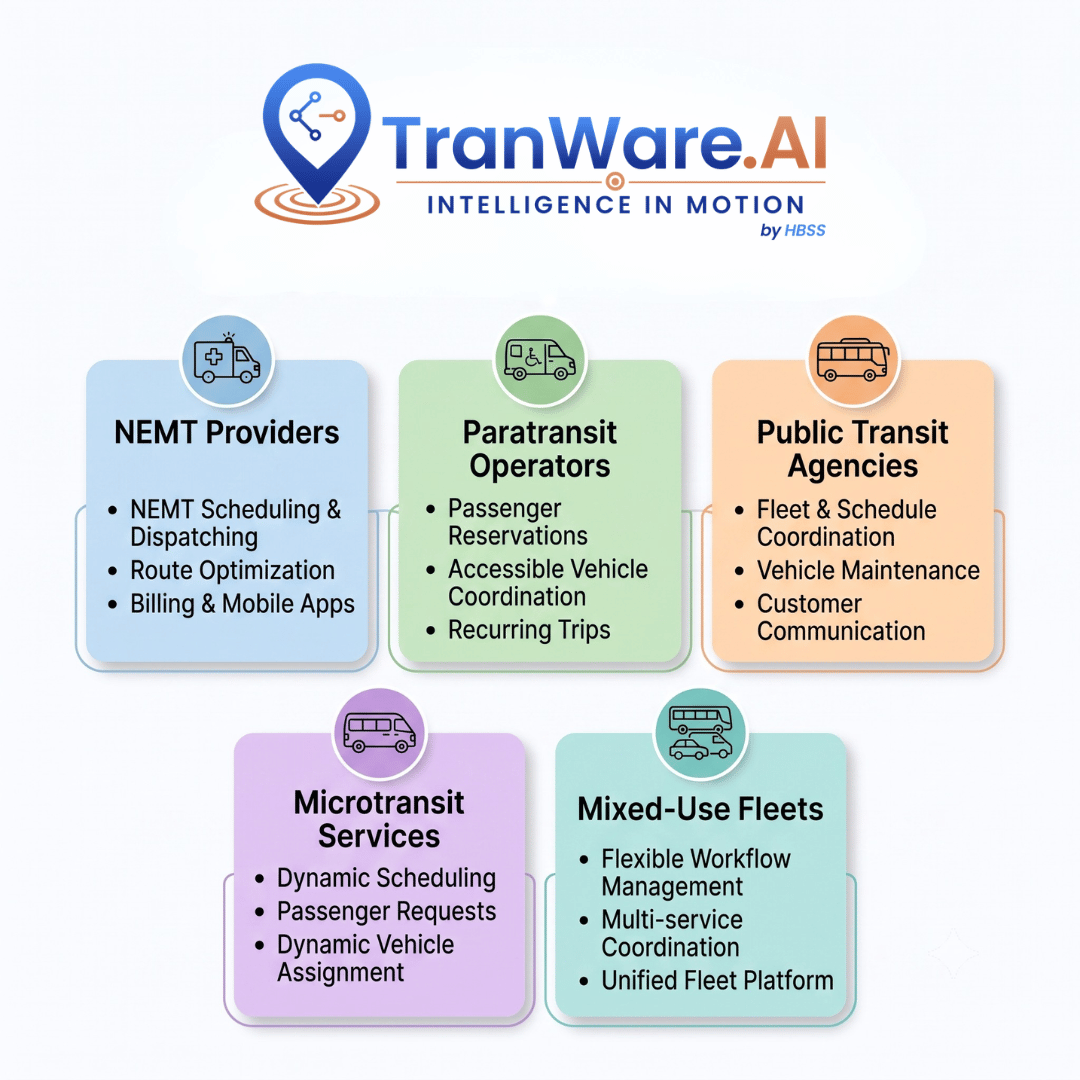
NEMT Providers
NEMT providers need software that can coordinate passengers, drivers, vehicles, schedules, routes, billing, and communications.
Important capabilities include:
- NEMT scheduling software
- NEMT dispatching software
- Route optimization
- Vehicle tracking
- Fleet maintenance
- Billing
- Mobile applications
- Customer communication
TranWare specifically positions its platform for NEMT operations.
Paratransit Operators
Paratransit operations often involve flexible scheduling and passengers with different mobility needs.
Paratransit software solutions can help coordinate:
- Passenger reservations
- Accessible vehicles
- Drivers
- Recurring trips
- Routes
- Dispatching
- Real-time tracking
- Notifications
- Billing
A connected platform can reduce the operational gaps that occur when these functions are managed separately.
Public Transit Agencies
Public transportation agencies can use transportation software to coordinate fleet operations, vehicle locations, schedules, maintenance, reporting, and customer communication.
A modern transit software platform can provide greater visibility across multiple operational areas.
Microtransit Services
Microtransit combines elements of fixed-route and on-demand transportation.
This makes technology particularly important for:
- Dynamic scheduling
- Passenger requests
- Vehicle assignment
- Route planning
- Real-time updates
- Driver communication
Mixed-Use Fleets
Organizations operating different types of transportation services need flexible software.
A fleet management platform should allow managers to coordinate different vehicles, drivers, service types, and operational workflows without forcing every operation into the same model.
TranWare positions its platform for mixed-use fleets in addition to NEMT, paratransit, public transportation, and microtransit.
TranWare AI Transportation Software: Core Technology Stack
| Operational Area | Technology | Primary Purpose |
| Scheduling | NEMT Scheduling Software | Organize trips and appointments |
| Dispatch | Transportation Dispatch Software | Assign drivers and vehicles |
| Routing | Route Optimization Software | Improve route efficiency |
| Tracking | Vehicle Tracking Software | Monitor fleet activity |
| Maintenance | Fleet Maintenance Software | Manage vehicle service |
| Safety | Incident Reporting Software | Record operational events |
| Mobile | Transportation Mobile App | Connect drivers and riders |
| Billing | NEMT Billing Software | Manage transportation billing |
| Payments | Transportation Payment Processing | Process rider payments |
| Calls | Automated Call Handling | Reduce repetitive phone work |
| AI | AI Transportation Software | Automate selected workflows |
| Analytics | Operations Reporting | Measure performance |
This integrated approach is important because transportation operations are interconnected. A scheduling decision can affect dispatch. Dispatch affects routing. Routing affects vehicle utilization. Vehicle utilization affects maintenance. Completed trips affect billing.
How to Choose Transportation Software
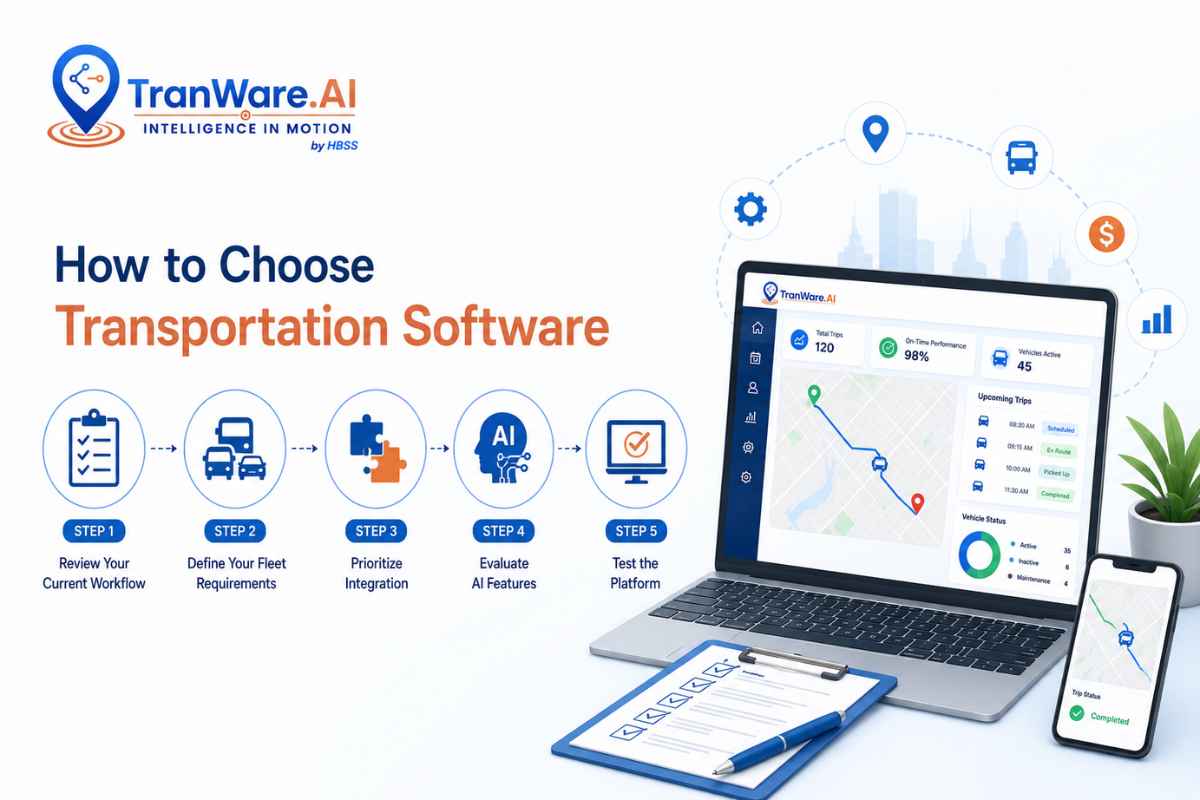
Choosing software for transport management should start with operational needs rather than a list of features.
Step 1: Review Your Current Workflow
Document how your organization handles:
- Reservations
- Scheduling
- Dispatch
- Route planning
- Driver communication
- Vehicle tracking
- Maintenance
- Billing
- Payments
- Customer service
- Reporting
Identify where staff perform repetitive manual tasks.
Step 2: Define Your Fleet Requirements
Consider:
- Number of vehicles
- Number of drivers
- Daily trip volume
- Vehicle types
- Service area
- Passenger requirements
- Number of dispatchers
- Number of locations
The best fleet management solutions should match your current operation while allowing future growth.
Step 3: Prioritize Integration
A platform becomes more valuable when operational data can move between systems without repeated manual entry.
Consider integrations with:
- GPS systems
- Payment systems
- Accounting platforms
- Healthcare transportation brokers
- APIs
- Mobile applications
- Communication systems
TranWare states that its custom solutions can integrate with major Medicaid transportation broker APIs, including Modivcare, MTM, MART, and WE Care.
Step 4: Evaluate AI Features
Do not select AI simply because a product has an “AI” label.
Ask:
- What tasks does AI actually automate?
- Can employees review AI-generated actions?
- Does AI reduce repetitive work?
- Is voice interaction available?
- Can AI assist with customer calls?
- Does AI support scheduling or dispatching?
- Can the platform use operational data effectively?
The goal should be measurable operational improvement.
Step 5: Test the Platform
Before selecting a transportation management system, request a demonstration.
Test real workflows such as:
- Create a trip.
- Schedule the passenger.
- Assign a vehicle.
- Assign a driver.
- Optimize the route.
- Track the vehicle.
- Update trip status.
- Complete the trip.
- Process billing.
- Generate a report.
A system should be easy for actual users—not just impressive during a sales presentation.
Requirements for a Modern Fleet Management Platform
A strong fleet management platform should provide a combination of operational, financial, safety, and customer-facing capabilities.
Essential Requirements
- Scheduling and dispatching
- Route optimization
- GPS vehicle tracking
- Fleet maintenance tracking
- Driver management
- Mobile applications
- Billing
- Payment processing
- Reporting
- Incident management
- Customer communication
- Integration capabilities
- Scalable architecture
Advanced Requirements
- AI-powered dispatch
- AI voice commands
- AI phone agents
- Digital vehicle inspections
- Real-time dashboards
- Automated passenger notifications
- Custom APIs
- Broker integrations
- Automated workflows
TranWare’s current platform includes many of these capabilities, including AI voice dispatch, AI phone agents, CRM, digital vehicle inspections, GPS and camera integration, and real-time operational visibility.
Manual Transportation Management vs. TranWare AI Transportation Software
Traditional transportation operations often depend on spreadsheets, phone calls, paper records, and disconnected applications. TranWare AI Transportation Software brings scheduling, dispatching, routing, tracking, maintenance, billing, communication, and reporting into a more connected transportation management environment. TranWare AI Transportation Software
| Area | Manual Process | TranWare AI Transportation Software |
| Scheduling | Spreadsheets, phone calls, and manual entries | Digital scheduling and automated workflows |
| Dispatch | Manual driver and vehicle assignment | Intelligent dispatching and AI-assisted operations |
| Routing | Manual route planning | Route optimization and smarter route planning |
| Tracking | Calling drivers for location updates | Real-time vehicle tracking and GPS visibility |
| Maintenance | Paper records and manual reminders | Digital fleet maintenance tracking and inspections |
| Billing | Manual data entry and reconciliation | Integrated billing and payment workflows |
| Passenger Updates | Individual phone calls | Automated notifications and communication |
| Incident Records | Paper forms and disconnected files | Digital incident reporting and centralized records |
| Analytics | Manually prepared reports | Centralized reporting and operational dashboards |
| Communication | Multiple disconnected channels | Connected communication and AI-powered call handling |
How TranWare AI Improves Transportation Operations
The main difference is connected data and workflows. With a manual process, information may need to be entered multiple times. For example, a dispatcher may receive a trip request by phone, enter it into a spreadsheet, call a driver, manually plan the route, and later provide billing information to another department.
With TranWare AI, these activities can be connected within a transportation management platform. The system supports scheduling and dispatching, route optimization, vehicle tracking, fleet maintenance, billing, mobile applications, payment processing, automated call handling, and other transportation operations. TranWare Solutions
The exact results will depend on fleet size, daily trip volume, geographic coverage, existing processes, and how the software is implemented. However, the goal remains the same: reduce disconnected manual work, improve operational visibility, and help transportation teams manage NEMT, paratransit, transit, and fleet operations more efficiently.
Step-by-Step: Implementing TranWare AI Transportation Software
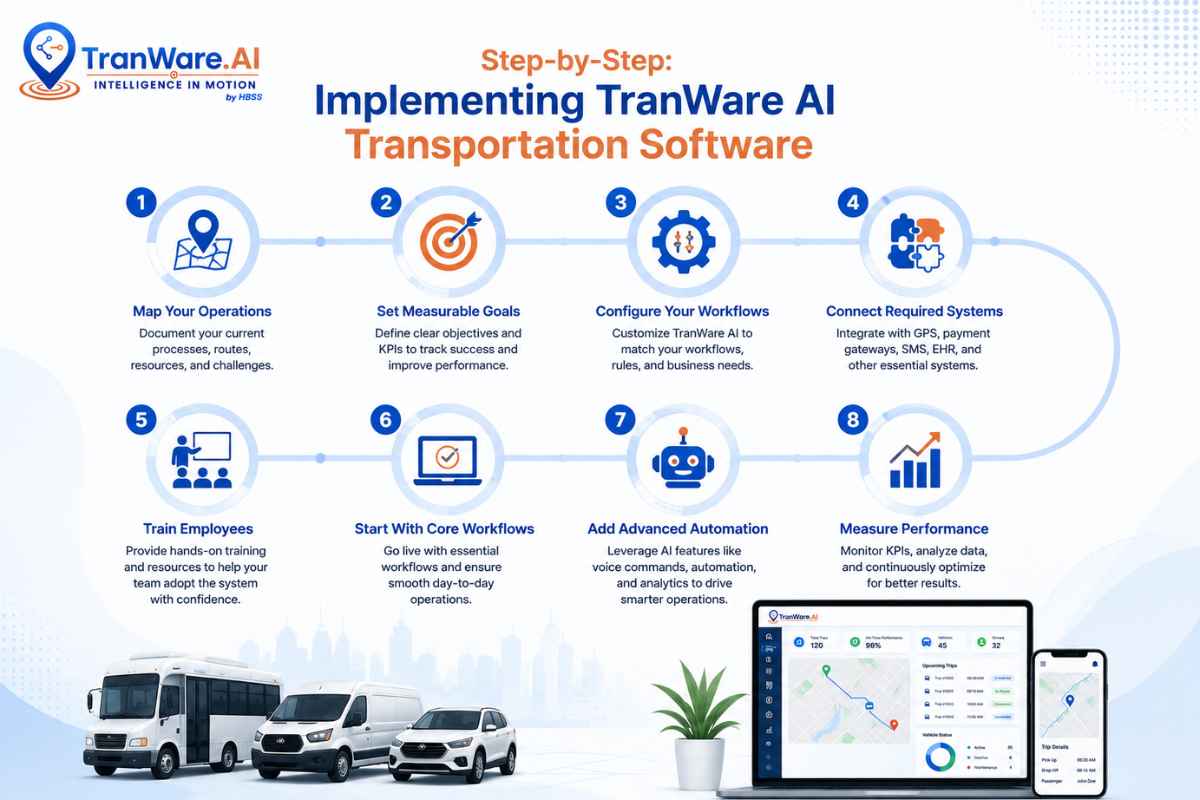
1. Map Your Operations
Start by documenting your current transportation workflow.
Identify bottlenecks, duplicate data entry, manual tasks, and communication gaps.
2. Set Measurable Goals
Choose clear goals such as:
- Reduce scheduling errors
- Improve on-time performance
- Increase vehicle utilization
- Reduce manual billing work
- Improve maintenance visibility
- Reduce repetitive calls
3. Configure Your Workflows
Set up:
- Vehicles
- Drivers
- Service areas
- Passenger requirements
- Trip types
- Scheduling rules
- Dispatch workflows
- Billing processes
4. Connect Required Systems
Configure GPS, payment, accounting, broker, mobile, or API integrations as needed.
5. Train Employees
Training should cover:
- Dispatchers
- Drivers
- Fleet managers
- Billing staff
- Customer service
- Administrators
6. Start With Core Workflows
Begin with essential operations such as scheduling, dispatching, tracking, and reporting.
7. Add Advanced Automation
After the core workflow is stable, introduce AI features, automated calls, digital inspections, and other automation capabilities.
8. Measure Performance
Track KPIs regularly.
Useful metrics include:
- On-time trip percentage
- Completed trips
- Cancellations
- No-shows
- Vehicle utilization
- Mileage
- Driver productivity
- Maintenance downtime
- Billing turnaround
- Customer complaints
Common Mistakes When Selecting Transportation Software
1. Choosing Software Based Only on Price
The cheapest option may not support the workflows your operation needs.
Compare total value, scalability, integrations, support, and operational impact.
2. Buying Separate Systems for Every Function
Separate systems can create duplicate data entry and disconnected information.
An integrated platform may reduce this complexity.
3. Ignoring Driver Experience
Drivers need simple tools that work while they are on the road.
A complicated driver application can reduce adoption.
4. Treating AI as a Replacement for People
AI is most useful when it handles repetitive tasks and supports employees.
Complex passenger, safety, or operational decisions may still require human judgment.
5. Forgetting About Future Growth
Do not select a system based only on today’s fleet size.
Consider what happens if you add:
- More vehicles
- More drivers
- More service areas
- More dispatchers
- More daily trips
- Additional transportation services
Expert Tips for Getting More Value From Transportation Software
1. Automate Repetitive Work First
Start with tasks employees perform repeatedly, such as recurring trip scheduling, reminders, status updates, and basic customer inquiries.
2. Connect Scheduling With Routing
Scheduling without route optimization can leave efficiency gains on the table.
Use scheduling and route planning together.
3. Use Real-Time Tracking for Exception Management
Dispatchers should not need to watch every vehicle constantly.
Use GPS visibility to identify delays, route deviations, and operational exceptions that need attention.
4. Make Maintenance Part of Daily Operations
Do not treat fleet maintenance as a separate administrative function.
Connect maintenance status with vehicle availability and dispatch planning.
5. Measure Results Before and After Automation
Before implementing TranWare AI Transportation Software, it is important to record your current performance. This creates a baseline that you can compare with results after the software is implemented.
Instead of assuming that automation is improving operations, transportation managers can use real performance data to measure the actual impact.
For example:
| KPI | What to Measure Before | What to Measure After |
| Daily Completed Trips | Average number of trips completed each day | Check whether the team can handle more trips with the same resources |
| On-Time Performance | Percentage of trips completed within the required time window | Compare whether scheduling and route optimization improve punctuality |
| Dispatcher Workload | Hours spent manually scheduling, assigning, and updating trips | Measure how much manual work is reduced through automation |
| Vehicle Utilization | How often vehicles are actively used versus sitting idle | Determine whether better scheduling and routing improve vehicle utilization |
| Manual Billing Hours | Time employees spend entering, checking, and reconciling billing information | Measure the reduction in manual billing and reconciliation work |
| Maintenance Downtime | Number of hours or days vehicles are unavailable because of maintenance | Determine whether better maintenance tracking helps reduce unexpected downtime |
Why These Measurements Matter
Suppose a transportation provider completes 500 trips per day before implementing new software. After implementation, the provider completes 600 trips per day without adding the same number of vehicles or dispatch staff. That could indicate improved scheduling, dispatching, and vehicle utilization.
Similarly, if dispatchers previously spent 30 hours per week on manual scheduling and that falls to 15 hours, the organization can identify a measurable reduction in administrative work.
The same approach can be applied to maintenance. If managers can schedule preventive maintenance more effectively and reduce unexpected vehicle downtime, more vehicles may remain available for scheduled trips.
The key is to measure the same KPIs before and after implementation. This creates a clear comparison and helps management determine whether the transportation software is improving efficiency, reducing manual work, and supporting better fleet operations.
This gives management a clear way to evaluate the software’s impact.
6. Build Around Exceptions
The strongest transportation workflows do not try to automate every decision.
Instead, automate predictable tasks and allow dispatchers to focus on unusual situations such as vehicle breakdowns, late drivers, cancellations, urgent schedule changes, and passenger needs.
Why TranWare AI Stands Out
TranWare combines traditional transportation management functions with newer AI capabilities.
The platform covers scheduling and dispatching, route optimization, fleet maintenance, incident reporting, mobile applications, driver cashiering, customer account billing, vehicle tracking, payment processing, automated call handling, and custom solutions.
Its newer AI capabilities extend this foundation with:
- AI Voice Dispatch & Verbal Commands
- AI eReps & AI Phone Agents
- AI-powered CRM and customer management
- Digital Vehicle Inspections
- GPS and camera integration
- Real-time operations visibility
TranWare states that it has 25 years of experience in the ground transportation industry and serves organizations across NEMT, paratransit, public transportation, microtransit, and mixed-use fleet operations.
For organizations that want to bring dispatching, routing, fleet operations, tracking, billing, communication, and automation into a connected transportation environment, this broad platform approach can be valuable.

Conclusion
Modern transportation operations require more than basic scheduling software. NEMT providers, paratransit operators, public transit agencies, and mixed-use fleets need connected tools that can coordinate trips, drivers, vehicles, routes, maintenance, billing, payments, communications, and reporting.
TranWare AI Transportation Software brings these capabilities together through a transportation management platform built for complex fleet operations. Its capabilities span NEMT scheduling and dispatching, route optimization, fleet management, vehicle tracking, maintenance, mobile applications, incident reporting, billing, payment processing, automated call handling, and AI-powered transportation workflows.
For transportation organizations planning their next technology investment, the priority should be clear: choose software that solves today’s operational challenges while supporting future growth. A connected platform can reduce manual work, improve visibility, strengthen fleet utilization, and give transportation teams more control over daily operations.
With its combination of transportation management functionality and AI capabilities, TranWare AI provides a technology foundation for smarter NEMT, paratransit, transit, and fleet operations. Contact Us to discuss how TranWare AI can support your organization’s transportation management and operational goals.
FAQs About TranWare AI Transportation Software
1. What is TranWare AI Transportation Software?
TranWare AI Transportation Software is a transportation management platform that combines scheduling, dispatching, route optimization, fleet management, vehicle tracking, billing, mobile applications, and AI-powered automation.
2. Who can use TranWare AI?
TranWare is designed for NEMT providers, paratransit operators, public transportation agencies, microtransit services, and mixed-use transportation fleets.
3. Does TranWare provide NEMT dispatch and scheduling software?
Yes. TranWare provides scheduling and dispatching capabilities for transportation operations, including NEMT workflows, vehicle assignment, trip management, and real-time operational visibility.
4. Can TranWare help manage fleet maintenance?
Yes. TranWare includes fleet maintenance capabilities such as maintenance scheduling, shift inspections, inventory management, and digital vehicle inspection functionality.
5. Does TranWare include vehicle tracking?
Yes. TranWare provides real-time tracking of vehicle location and status to support fleet visibility and transportation operations.
Interesting Reads: