

Choosing the right Transportation Management Software (TMS) can have a major impact on how efficiently a transportation organization schedules trips, dispatches vehicles, manages fleets, optimizes routes, tracks vehicles, processes payments, and serves customers.
Modern TMS platforms are no longer limited to basic transportation planning. Depending on the platform, they can support route optimization, automated dispatching, real-time visibility, fleet management, billing, analytics, integrations, and AI-powered decision-making.
However, the best Transportation Management Software depends on the type of operation being managed. A global freight shipper may need multimodal transportation planning and carrier management, while an NEMT provider may prioritize patient trip scheduling, vehicle assignment, Medicaid-related workflows, real-time dispatching, billing, and driver management.
This guide compares five leading Transportation Management Software platforms in 2026 and explains what each platform is best suited for.

Quick Answer: What Is the Best Transportation Management Software in 2026?
The best Transportation Management Software depends on your transportation model, fleet size, operational complexity, and required features. TranWare AI is particularly suited to NEMT, paratransit, public transportation, microtransit, and mixed-use fleets, while platforms such as Locus, Oracle Transportation Management, SAP Transportation Management, and Blue Yonder are strongly positioned around enterprise logistics and freight transportation.
What Is Transportation Management Software (TMS)?
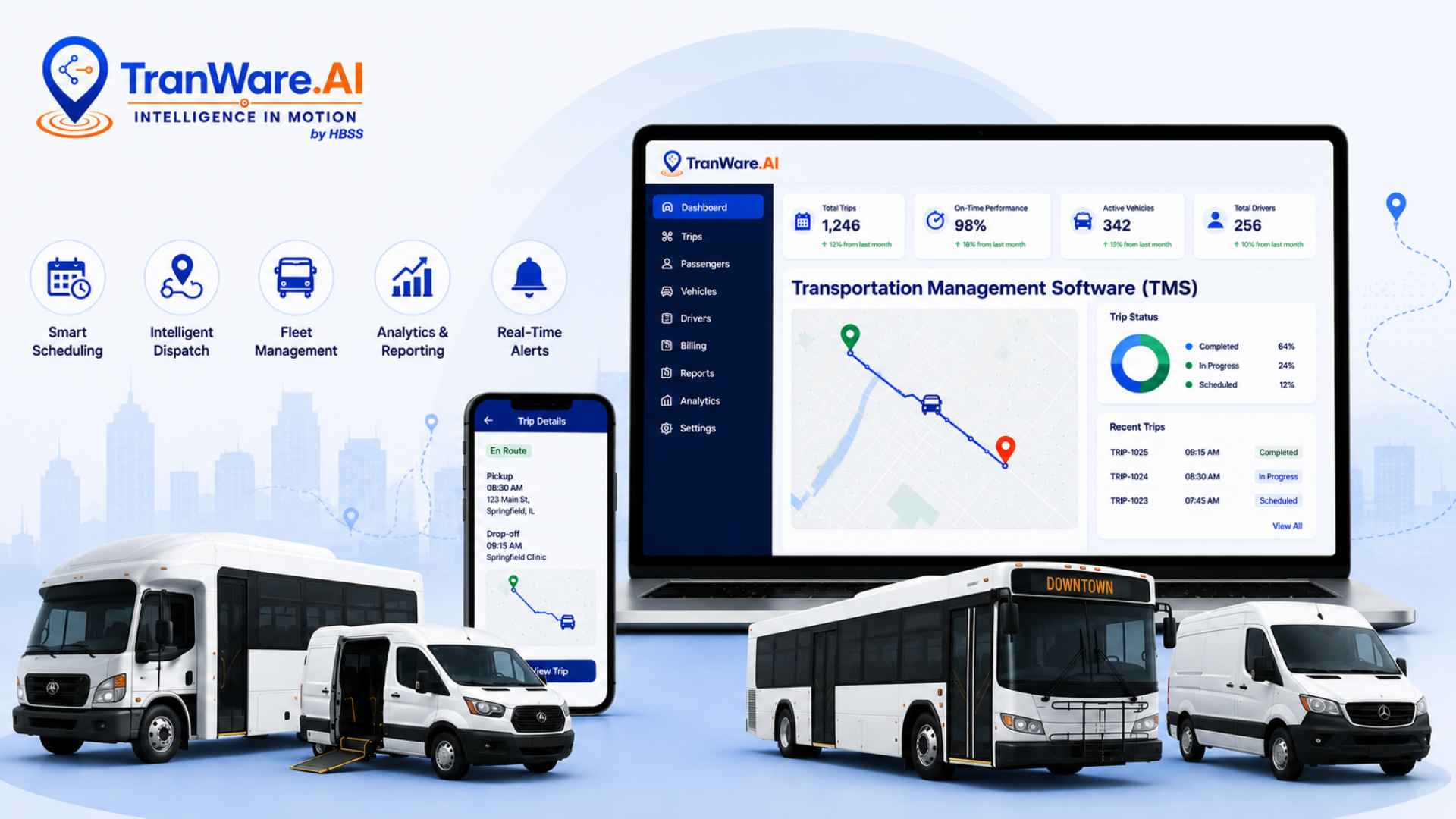
Transportation Management Software, commonly called a Transportation Management System or TMS, is technology used to plan, manage, execute, monitor, and optimize transportation operations.
A TMS can bring multiple transportation processes into one platform, including:
- Transportation scheduling
- Dispatch management
- Route optimization
- Fleet management
- Vehicle tracking
- Driver management
- Billing and payment processing
- Transportation reporting
- Customer communication
- Mobile applications
- Transportation automation
- Performance analytics
The exact capabilities vary by platform and transportation use case.
For example, enterprise freight TMS platforms may emphasize carrier selection, freight planning, tendering, multimodal transportation, freight settlement, and supply-chain integration. Oracle Transportation Management supports planning from point-to-point transportation through complex multimodal and multileg operations, along with automated freight billing and payment.
By comparison, TranWare AI focuses on passenger transportation operations, including NEMT, paratransit, public transportation, microtransit, and mixed-use fleets.
How We have Selected the Top Transportation Management Software
A useful TMS comparison should look beyond the number of features listed on a vendor website. Transportation providers should consider whether a platform actually fits their operating model.
For this comparison, we considered the following factors:
1. Transportation Scheduling and Dispatching
A strong TMS should make it easier to schedule transportation requests, assign vehicles and drivers, manage changes, and coordinate daily operations.
2. Route Optimization
Route optimization can help transportation providers create more efficient routes while considering pickup and drop-off requirements, vehicle availability, timing, and operational constraints.
3. Fleet Management
Fleet management capabilities are important for organizations responsible for vehicles, drivers, maintenance schedules, inspections, and fleet utilization.
4. Real-Time Visibility
Vehicle and transportation tracking can help dispatchers monitor active operations and respond to delays, cancellations, breakdowns, and other changes.
5. Billing and Payments
Transportation billing and payment capabilities can reduce manual financial processes and connect completed trips with invoicing and payment workflows.
6. Automation and AI
Modern transportation software increasingly incorporates AI and automation to reduce repetitive work and improve operational decision-making.
7. Industry Fit
A TMS should match the transportation environment. A freight-focused TMS may not provide the same workflows required by NEMT or paratransit providers.
Top 5 Transportation Management Software Solutions in 2026
1. TranWare AI — Best for NEMT, Paratransit, Public Transit and Mixed-Use Fleets
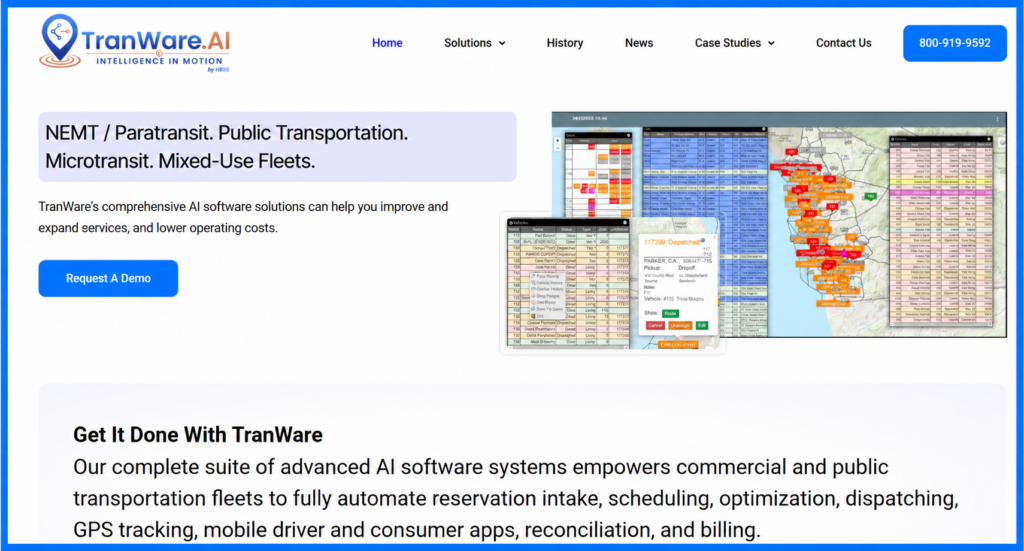
TranWare AI is a transportation management software platform designed specifically around complex passenger transportation and fleet operations.
The platform supports NEMT, paratransit, public transportation, microtransit, and mixed-use fleets, making it different from many traditional freight-oriented TMS platforms.
TranWare combines transportation scheduling, dispatching, route optimization, fleet maintenance, vehicle tracking, billing, payment processing, mobile applications, and automated communications within its transportation management platform.
Key TranWare AI Features
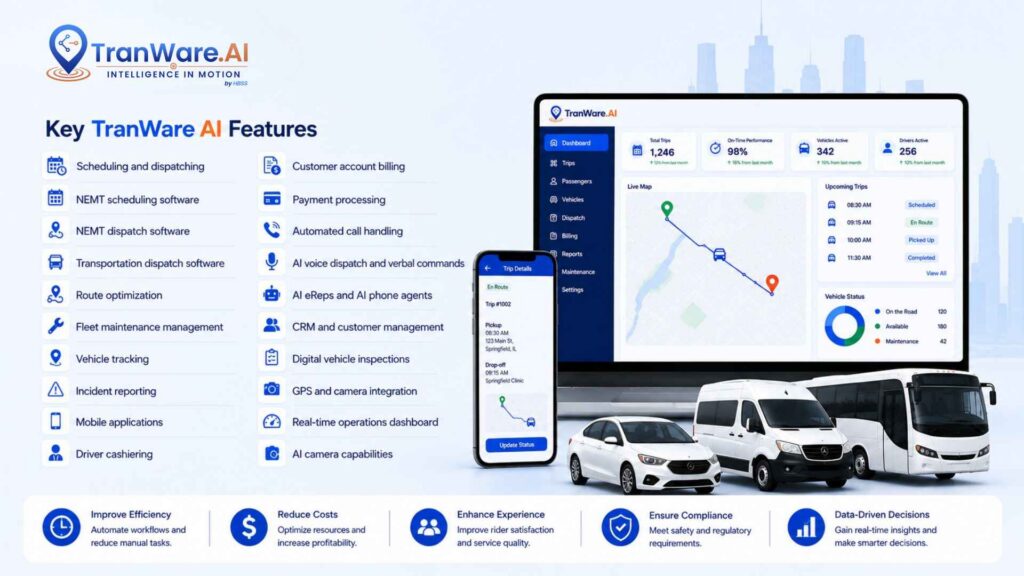
- Scheduling and dispatching
- NEMT scheduling software
- NEMT dispatch software
- Transportation dispatch software
- Route optimization
- Fleet maintenance management
- Vehicle tracking
- Incident reporting
- Mobile applications
- Driver cashiering
- Customer account billing
- Payment processing
- Automated call handling
- AI voice dispatch and verbal commands
- AI eReps and AI phone agents
- CRM and customer management
- Digital vehicle inspections
- GPS and camera integration
- Real-time operations dashboard
- AI camera capabilities
Scheduling and Dispatching
TranWare provides automated and manual dispatching capabilities, with real-time GPS information helping dispatchers see where vehicles are located. The system can support dispatch by vehicle location, zone, queue position, or combinations of operational requirements.
It also supports customer trip history, driver and customer profiles, standing orders, Medicaid interfaces, driver scheduling, and integrated payment processing.
Route Optimization
TranWare Route Optimization supports next-day batch and real-time multi-load scheduling and optimization.
The optimization process can consider pickup and drop-off locations, requested times, vehicle types, and requirements such as wheelchair accessibility, lift vehicles, or stretcher requirements. Changes to trips can also be reprocessed through the optimizer.
Fleet Management and Maintenance
Fleet maintenance capabilities include preventive maintenance schedules, vehicle inspections, parts inventory management, automated ordering, vendor management, and real-time reporting.
Vehicle Tracking
TranWare provides real-time vehicle tracking through its WebDispatcher environment. Dispatchers can monitor vehicle status, view pending jobs, communicate with vehicles, replay routes, and visualize zone boundaries.
Best For
TranWare AI is best suited for:
- NEMT providers
- Paratransit operators
- Public transportation agencies
- Microtransit services
- Mixed-use transportation fleets
- Transportation companies requiring integrated scheduling and dispatching
- Fleet operators requiring billing, tracking, maintenance, and passenger transportation tools
TranWare AI vs. Traditional Transportation Management Software
Traditional TMS platforms often concentrate on freight, shipment, carrier, and supply-chain processes.
TranWare AI takes a different approach by focusing heavily on ground passenger transportation and fleet operations.
| Capability | TranWare AI |
| Transportation scheduling | Yes |
| Automated dispatching | Yes |
| NEMT scheduling | Yes |
| NEMT dispatching | Yes |
| Route optimization | Yes |
| Paratransit optimization | Yes |
| Fleet maintenance | Yes |
| Vehicle tracking | Yes |
| Incident reporting | Yes |
| Driver mobile tools | Yes |
| Passenger applications | Yes |
| Driver cashiering | Yes |
| Customer account billing | Yes |
| Payment processing | Yes |
| Automated call handling | Yes |
| AI voice dispatch | Yes |
| AI phone agents | Yes |
| AI-powered CRM | Yes |
| Digital vehicle inspections | Yes |
| GPS and camera integration | Yes |
| Real-time operations dashboard | Yes |
| AI camera capabilities | Yes |
| Custom transportation solutions | Yes |
The capabilities above are based on TranWare’s current Solutions and product pages.
Why Choose TranWare AI?
The biggest differentiator is industry-specific transportation management.
Instead of positioning itself solely as a general freight TMS, TranWare AI brings together passenger transportation workflows and fleet management capabilities for organizations that need to coordinate trips, passengers, drivers, vehicles, routes, billing, and daily transportation operations.
2. Locus — Best for Enterprise Delivery and Logistics Orchestration
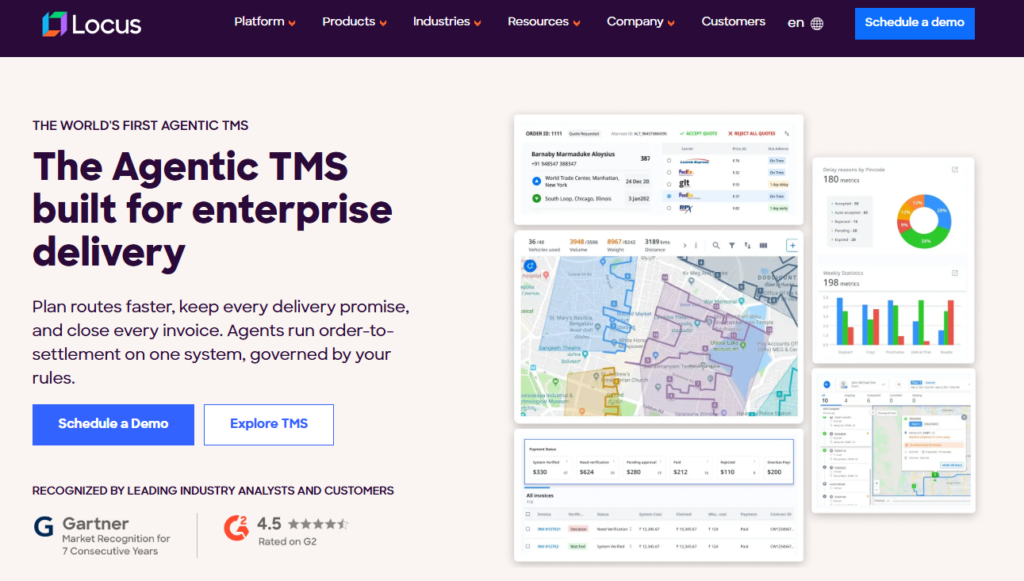
Locus is an AI-powered transportation management and logistics orchestration platform focused on enterprise delivery networks.
Its 2026 TMS comparison describes capabilities including automated dispatch, dynamic route optimization, real-time control tower visibility, ERP/WMS integration, and exception management.
Key Features
- Automated dispatch
- Route optimization
- Real-time visibility
- Control tower capabilities
- Delivery orchestration
- Exception management
- ERP and WMS integrations
- Fleet and delivery optimization
- Analytics and reporting
Best For
Locus is particularly relevant for enterprise shippers, retailers, 3PLs, and organizations managing complex, high-density delivery networks.
What Makes It Different?
Locus focuses heavily on AI-driven logistics orchestration, automated dispatching, real-time decision-making, and delivery optimization.
It is therefore a strong consideration for organizations whose primary challenge is managing complex freight and delivery networks.
3. Oracle Transportation Management — Best for Global Enterprise Transportation
Oracle Transportation Management (OTM) is an enterprise Transportation Management Software platform designed to manage transportation activity across global supply chains.
Oracle supports transportation planning from simple point-to-point movements to complex multimodal, multileg, and cross-dock operations. It also includes transportation execution, freight billing and payment, fleet planning, and transportation intelligence.
Key Features
- Transportation planning
- Multimodal transportation
- Multileg transportation
- Carrier and logistics collaboration
- Automated shipment monitoring
- Freight billing
- Payment management
- Fleet planning
- Transportation intelligence
- Machine-learning-based transit-time prediction
Oracle also incorporates machine learning into transportation planning to improve estimated transit times and respond to real-time events such as GPS updates, traffic, and disruptions.
Best For
Oracle Transportation Management is a strong option for large organizations managing complex global supply-chain transportation requirements.
What Makes It Different?
Its strength is the breadth of enterprise transportation capabilities and its ability to support complex global transportation networks.
4. SAP Transportation Management — Best for SAP-Centered Enterprises
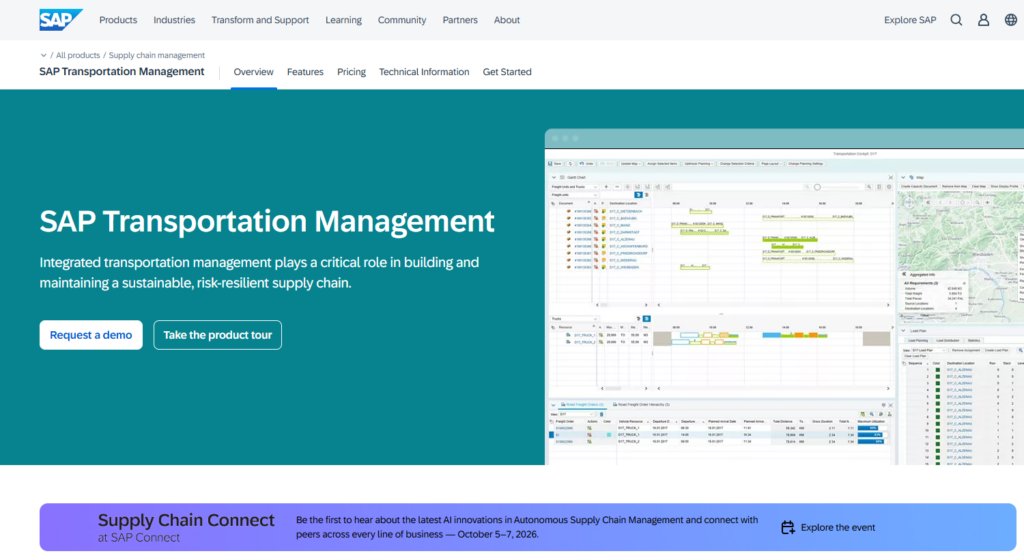
SAP Transportation Management provides transportation planning and execution capabilities within the SAP ecosystem.
The platform supports strategic freight management, order management, transportation planning, dynamic replanning, carrier-related processes, and driver resource management.
Key Features
- Freight planning
- Transportation planning
- Dynamic replanning
- Carrier selection
- Transportation tendering
- Rate determination
- Order and delivery integration
- Driver resource management
- Load planning
- Transportation analytics
- SAP integrations and APIs
SAP’s transportation planning capabilities can use manual, map-based, and automated planning approaches to balance freight costs and service requirements.
Best For
SAP Transportation Management is particularly suitable for organizations already operating extensively within the SAP ecosystem.
What Makes It Different?
Its major advantage is the ability to connect transportation processes with broader enterprise systems and supply-chain workflows.
5. Blue Yonder Transportation Management — Best for Complex Multimodal Supply Chains
Blue Yonder Transportation Management combines transportation planning, optimization, execution, visibility, and AI-driven capabilities.
Its platform supports transportation modeling, procurement, optimization and planning, load building, transportation execution, fleet management, and network connectivity.
Key Features
- Transportation planning
- Route optimization
- Load planning
- Carrier procurement
- Fleet management
- Transportation execution
- Network visibility
- Multimodal transportation
- AI-driven optimization
- Mobile transportation communications
- Exception management
Blue Yonder also describes transportation execution capabilities for private and dedicated fleets, common carriers, multiple modes, real-time visibility, and AI-assisted disruption management.
Best For
Blue Yonder is a strong option for large organizations managing complex transportation networks across multiple modes, regions, carriers, and supply-chain operations.
What Makes It Different?
The platform places strong emphasis on connecting transportation planning and execution while using optimization, network visibility, and AI to respond to changing transportation conditions.
Quick Comparison: Top 5 TMS Software in 2026
| Transportation Management Software | Best For | Scheduling & Dispatch | Route Optimization | Fleet Management | Vehicle Visibility | Billing | AI / Automation | Overall Fit |
| TranWare AI | NEMT, paratransit, public transit, microtransit & mixed fleets | ✓ | ✓ | ✓ | ✓ | ✓ | ✓ | ★★★★★ Best Overall for Specialized Transportation |
| Locus | Enterprise delivery & logistics | ✓ | ✓ | ✓ | ✓ | — | ✓ | ★★★ |
| Oracle Transportation Management | Global enterprise supply chains | ✓ | ✓ | ✓ | ✓ | ✓ | ✓ | ★★★ |
| SAP Transportation Management | SAP-centered enterprises | ✓ | ✓ | ✓ | ✓ | ✓ | ✓ | ★★★ |
| Blue Yonder TMS | Complex multimodal supply chains | ✓ | ✓ | ✓ | ✓ | ✓ | ✓ | ★★★ |
What Features Should You Look for in Transportation Management Software?
Before selecting a TMS, transportation providers should evaluate the features that directly affect their daily operations.
Scheduling and Dispatch
Look for flexible scheduling, automated dispatching, driver assignment, standing orders, trip management, and real-time operational updates.
Route Optimization
The system should be capable of creating efficient routes based on your transportation requirements rather than simply calculating the shortest distance.
For NEMT and paratransit, this may include pickup windows, vehicle types, accessibility requirements, and special passenger needs.
Fleet Management
Fleet management capabilities should cover vehicle maintenance, inspections, parts, driver management, utilization, and operational reporting.
Real-Time Vehicle Tracking
Real-time tracking gives dispatchers greater visibility into vehicle location and status and can support faster responses to delays and operational changes.
Billing and Payment Processing
Transportation billing software should help connect completed trips with invoicing, payment processing, reconciliation, and financial reporting.
Mobile Applications
Driver and passenger mobile applications can improve communication and provide access to transportation information outside the dispatch office.
AI and Automation
AI-powered tools can automate repetitive tasks such as trip inquiries, customer communication, scheduling support, dispatch commands, reminders, and operational monitoring.
TranWare AI currently offers AI voice dispatch and verbal commands, AI eReps and AI phone agents, AI-assisted vehicle inspections, AI-powered CRM capabilities, and AI-enabled camera functionality.
How Much Does Transportation Management Software Cost?
TMS pricing varies significantly between vendors and transportation operations.
The total cost can depend on:
- Number of vehicles
- Number of users
- Trip or shipment volume
- Required modules
- Number of locations
- Integrations
- Customization requirements
- Implementation services
- Training
- Support requirements
Enterprise TMS providers frequently use customized pricing because transportation networks differ considerably in size and complexity. The Locus comparison, for example, notes that enterprise TMS pricing can vary based on shipment volume, regions, modules, integrations, implementation scope, and support requirements.
For this reason, transportation providers should compare total cost of ownership, not just the monthly software subscription.
How to Choose the Best Transportation Management Software
The best TMS is not necessarily the platform with the longest feature list.
Start by identifying your transportation model.
If you manage NEMT or paratransit
Prioritize:
- NEMT scheduling
- NEMT dispatch software
- Passenger trip management
- Route optimization
- Vehicle accessibility requirements
- Medicaid-related workflows
- Driver management
- Billing and reconciliation
- Real-time vehicle tracking
If you manage public transportation
Consider:
- Fixed-route management
- Real-time vehicle tracking
- Passenger information
- Scheduling
- Driver management
- Route planning
- Reporting
- Mobile applications
If you manage enterprise freight
Prioritize:
- Multimodal transportation
- Carrier management
- Freight planning
- Tendering
- Load optimization
- Shipment visibility
- Freight billing
- ERP/WMS integrations
If you manage mixed-use fleets
Look for a flexible Transportation Management Software platform that can support different transportation services within a connected operational environment.
Why TranWare AI Stands Out
The biggest difference between TranWare AI and many traditional Transportation Management Software platforms is the transportation environment it is designed to support.
TranWare focuses on ground transportation operations across NEMT, paratransit, public transportation, microtransit, and mixed-use fleets.
Instead of treating scheduling, dispatching, fleet management, tracking, billing, and passenger services as separate systems, TranWare brings these capabilities together.
Its platform includes scheduling and dispatching, route optimization, fleet maintenance, incident reporting, mobile applications, driver cashiering, customer account billing, vehicle tracking, payment processing, automated call handling, and custom solutions.
For organizations that need more than a traditional freight TMS, this integrated approach can provide a better fit for passenger transportation operations.

Editor Notes
The best Transportation Management Software (TMS) in 2026 depends on your organization’s transportation model, operational complexity, fleet requirements, and technology environment.
Locus is positioned around enterprise delivery and logistics orchestration, while Oracle Transportation Management, SAP Transportation Management, and Blue Yonder provide broad enterprise transportation capabilities for complex supply-chain operations.
TranWare AI stands out for organizations operating NEMT, paratransit, public transportation, microtransit, and mixed-use fleets. Its combination of scheduling, dispatching, route optimization, fleet management, vehicle tracking, billing, payment processing, mobile applications, and AI-powered transportation tools makes it a strong option for passenger transportation providers looking for an integrated transportation management platform.
Before selecting a TMS, evaluate the platform against your actual workflows, fleet requirements, integrations, scalability needs, and long-term operating goals. The right Transportation Management Software should not simply manage transportation—it should help your team operate it more efficiently.
Frequently Asked Questions
1. What is Transportation Management Software (TMS)?
Transportation Management Software, or TMS, is a digital platform used to manage transportation planning, scheduling, dispatching, routing, tracking, fleet operations, billing, and other transportation workflows.
2. What is the best Transportation Management Software in 2026?
The best TMS depends on the type of transportation operation. TranWare AI is particularly suited to NEMT, paratransit, public transportation, microtransit, and mixed-use fleets, while other platforms may be better suited to enterprise freight and supply-chain operations.
3. Is TMS the same as fleet management software?
Not exactly. Fleet management software primarily focuses on vehicles, drivers, maintenance, tracking, and fleet performance. TMS generally covers a broader set of transportation planning and execution workflows.
4. Does TranWare AI provide NEMT dispatch software?
Yes. TranWare provides scheduling and dispatching capabilities designed for NEMT and other passenger transportation operations, including automated dispatching, driver scheduling, trip management, and real-time GPS tracking.
5. Does TranWare AI include route optimization?
Yes. TranWare Route Optimization supports next-day batch and real-time multi-load route scheduling and optimization, including configurable vehicle and trip requirements.
About TranWare AI
TranWare AI is a transportation technology platform focused on the ground transportation industry. The company states that it has 25 years of experience serving the industry and provides technology for NEMT, paratransit, public transportation, microtransit, and mixed-use fleets.
Its platform combines transportation scheduling, dispatching, route optimization, fleet management, vehicle tracking, billing, payment processing, mobile applications, and AI-powered transportation capabilities in one connected environment.
Request a Demo: Contact TranWare AI to discuss your transportation management requirements.
Interesting Reads:
TranWare AI: The Complete Guide to Smart NEMT, Paratransit and Fleet Management Solutions
Best Custom Transportation Software Solutions for NEMT and Paratransit Operations