
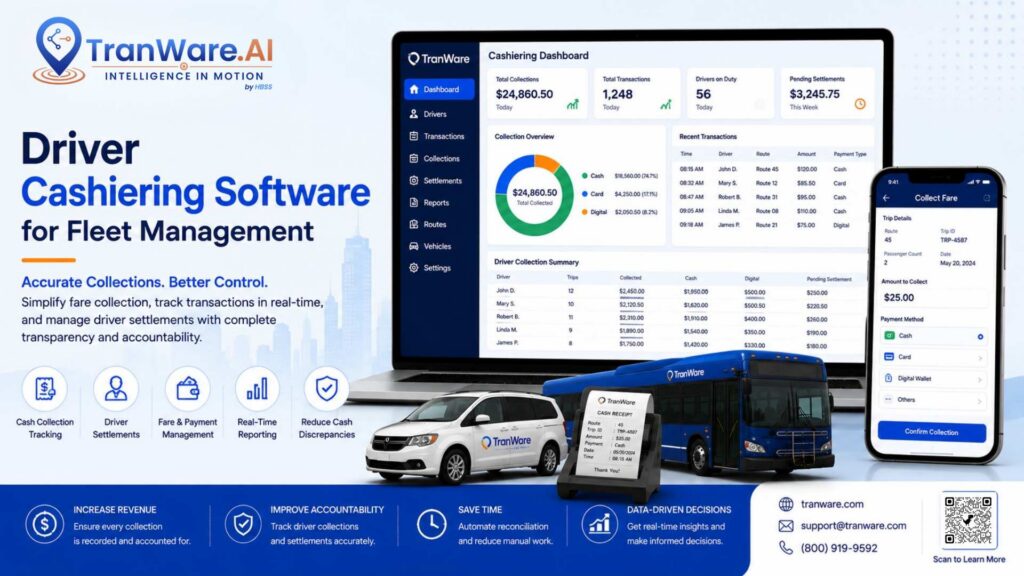
Driver payments can involve a lot more than simply collecting money at the end of a shift. Transportation companies often need to keep up with driver shifts, commissions, account and credit card trips, deposits, loans, recurring charges, receipts, and payment reconciliation. Driver Cashiering Software brings all of these tasks into one place, making it easier to keep financial records organized and up to date.
For transportation providers in the U.S., having the right cashiering system can save time, reduce manual work, and give managers a clearer view of driver accounts and fleet finances. In this guide, we’ll look at what Driver Cashiering Software is, how it works, the benefits it offers, the features worth considering, common mistakes to avoid, and how TranWare helps simplify driver cashiering and trip reconciliation.
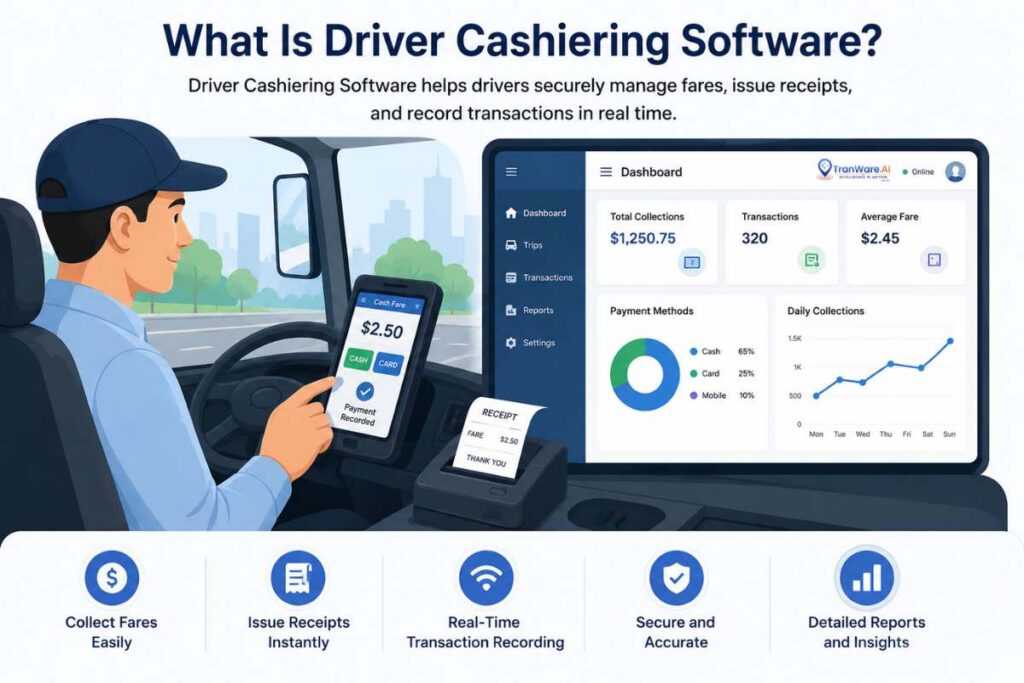
What Is Driver Cashiering Software?
Driver Cashiering Software is a transportation management solution that helps companies manage driver shifts, cash transactions, trip payments, commissions, receipts, account balances, and reconciliation.
It can help transportation operators:
- Create and close driver shifts
- Track driver accounts and transactions
- Reconcile completed trips
- Calculate driver commissions
- Manage loans and deposits
- Record recurring charges
- Generate receipts and cash reports
- Connect financial activity with transportation operations
Key Benefits of Driver Cashiering Software
A well-designed Transportation Cashiering Software platform can help transportation businesses:
- Reduce manual financial data entry
- Improve payment accuracy
- Manage different driver shift structures
- Reconcile completed trips more efficiently
- Calculate driver commissions based on configured trip rates
- Track driver loans and deposits
- Manage recurring driver charges
- Generate detailed receipts
- Create cash proof and reconciliation reports
- Improve financial visibility across the fleet
- Connect cashiering with broader transportation workflows
The goal is simple: make driver financial management more organized, consistent, and easier to monitor.
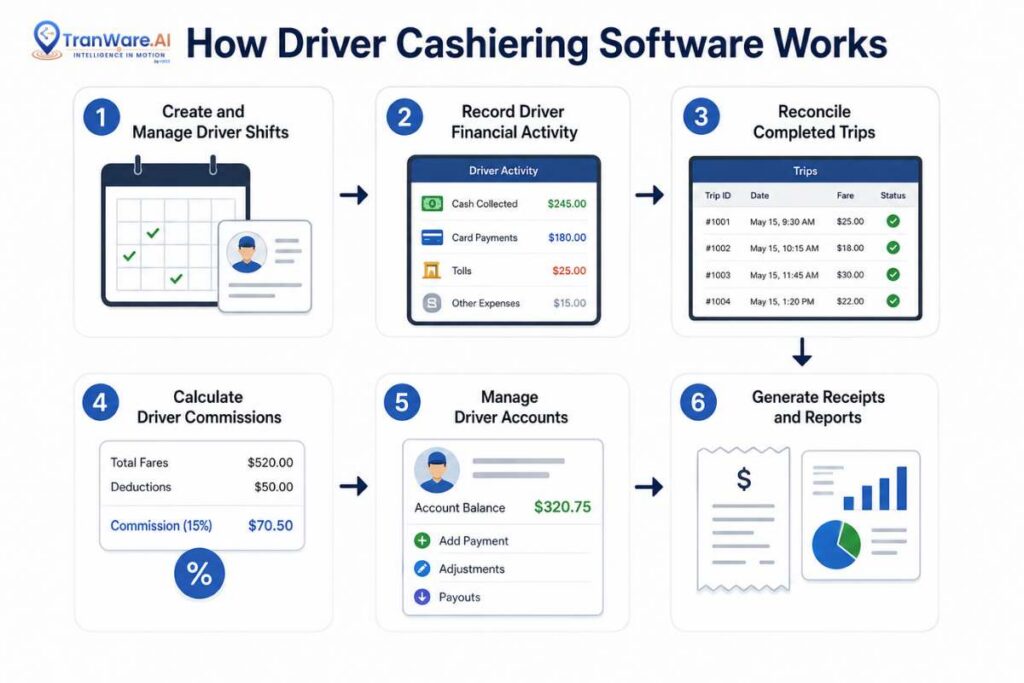
How Driver Cashiering Software Works
1. Create and Manage Driver Shifts
Driver shifts are the starting point for many cashiering workflows.
Different transportation businesses may use different compensation structures. For example, one fleet may pay drivers hourly, while another may use commissions or lease arrangements.
TranWare supports four major shift structures:
- Lease
- Commission
- Salary
- Hourly
The system also supports hourly, daily, multi-day, and weekly recurring shifts. Drivers can create and close shifts from TranAir MDT applications.
This flexibility is useful for fleets that operate different types of transportation services or have drivers with different employment and payment structures.
2. Record Driver Financial Activity
A driver may have several types of financial transactions associated with their account.
A transportation cashiering platform can help organize:
- Trip-related payments
- Driver commissions
- Security deposits
- Vehicle loans
- Equipment loans
- Insurance charges
- Dispatch fees
- Other recurring transactions
Instead of keeping these records in different files, companies can maintain a centralized driver account history.
3. Reconcile Completed Trips
Trip reconciliation is one of the most important parts of driver cashiering.
Suppose a driver completes 20 trips during a shift. Some trips may be account-billed, while others may be paid by credit card. The company needs to make sure completed trips are properly recorded and associated with the driver’s financial activity.
TranWare’s trip redemption feature supports reconciliation of completed account and credit-card trips. The system can automatically credit drivers for eligible billed or charged trips and calculate commissions using configurable trip-rate settings.
4. Calculate Driver Commissions
Commission-based transportation businesses need accurate calculations.
For example, if a company configures a 20% driver commission on an eligible $50 trip:
$50 × 20% = $10 driver commission
If 10 eligible trips each generate $50:
10 × $50 = $500 in trip revenue
At a 20% commission:
$500 × 20% = $100 driver commission
This is only an illustrative example, not a standard industry commission rate. Actual rates should be based on the company’s contracts, policies, and configured trip rules.
A configurable commission system helps companies apply their own rate structures instead of relying on one fixed calculation.
5. Manage Driver Accounts
Driver financial management can include more than trip revenue.
TranWare supports driver accounts covering loans, security deposits, and recurring transactions. The system can also manage vehicle purchases, arrears balance payoffs, equipment loans, insurance premiums, and dispatch fees.
This makes Fleet Cashiering Management more comprehensive because financial activity can be managed as part of the driver’s operational account.
6. Generate Receipts and Reports
Documentation is important when money changes hands.
Driver cashiering software can generate receipts and reports that help managers verify transactions and review financial activity.
TranWare provides detailed cashiering receipts and cash proof reports designed to support reconciliation.
Important Features of Driver Cashiering Software
When comparing Driver Cashiering Software, transportation companies should evaluate features based on their actual workflow.
Flexible Shift Management
Look for support for different shift types and schedules.
A flexible platform should accommodate operations such as:
- Hourly shifts
- Daily shifts
- Multi-day shifts
- Weekly recurring shifts
- Lease arrangements
- Commission structures
- Salary structures
Driver Payment Reconciliation
Driver Payment Reconciliation Software should make it easier to compare completed trips with recorded financial transactions.
This is particularly important when transportation businesses process different payment methods.
Driver Account Management
The software should provide a clear view of driver-related financial accounts, including deposits, loans, charges, and payments.
Commission Calculation
Look for configurable commission rules that can support different trip rates and payment arrangements.
Receipts and Cash Reports
Detailed receipts and cash proof reports can help managers verify transactions and identify discrepancies.
Accounting Integration
TranWare’s cashiering module includes a double-entry general ledger system and user-definable accounts for credits and debits.
This is important because driver cashiering should not operate as an isolated process from the company’s broader financial workflow.
Driver Cashiering Software Data at a Glance
The following table summarizes several concrete capabilities available through TranWare’s cashiering solution.
| Capability | Supported Details |
| Shift structures | 4: lease, commission, salary, hourly |
| Shift schedules | Hourly, daily, multi-day, weekly recurring |
| Trip payment types | Account-billed and credit-card trips |
| Driver account areas | Loans, security deposits, recurring transactions |
| Recurring charges | Examples include insurance premiums and dispatch fees |
| Commission management | Configurable trip-rate calculations |
| Financial accounting | Double-entry G/L system |
| Documentation | Detailed receipts and cash proof reports |
| Driver interface | TranAir MDT applications |
These figures and capabilities come from TranWare’s published Driver Cashiering and Redemption solution. TranWare states that it has focused on the ground transportation industry for 25 years.
Driver Cashiering Software vs. Manual Cashiering
| Factor | Manual Cashiering | Driver Cashiering Software |
| Shift tracking | Spreadsheets or paper | Digital shift management |
| Commission calculation | Manual formulas | Configurable calculations |
| Trip reconciliation | Manual checking | Structured redemption workflow |
| Receipts | Paper or separate files | Digital receipt generation |
| Driver accounts | Multiple records | Centralized account management |
| Recurring charges | Manual updates | Automated transaction management |
| Reporting | Spreadsheet-based | Cash proof and financial reports |
| Auditability | Difficult to review | More organized transaction history |
| Scalability | Becomes harder as trips grow | Designed for larger workflows |
Manual processes can work for very small fleets. However, as the number of drivers, trips, shifts, and transactions increases, maintaining accuracy becomes more difficult.
How Driver Cashiering Connects With Fleet Operations
Driver financial management does not exist separately from transportation operations.
Modern fleet management software can connect information across scheduling, dispatch, routing, vehicle tracking, maintenance, incident reporting, and billing.
For example:
Trip scheduled → Driver assigned → Trip completed → Payment recorded → Trip reconciled → Driver credited → Commission calculated
When these steps are connected, managers have better visibility into the full transportation workflow.
This is especially useful when Driver Cashiering Software works alongside:
- Transport management software
- NEMT dispatch software
- Route Optimization Software
- Driver tracking software
- Incident Tracking Software
- Transportation Billing Software
- Fleet Management Mobile App
- Fleet management solutions
Driver Cashiering and NEMT Operations
NEMT providers often manage high volumes of scheduled trips involving passengers, drivers, vehicles, facilities, and transportation brokers.
In this environment, payment reconciliation can become complicated when trips are billed through different channels.
NEMT dispatch software can manage scheduling and dispatch, while cashiering tools can support the financial workflow after trips are completed.
For example:
- A passenger trip is scheduled.
- A driver is assigned.
- The trip is completed.
- The completed trip is recorded.
- The applicable payment method is identified.
- The trip enters the reconciliation process.
- Driver compensation is calculated based on configured rules.
This creates a more connected workflow between operations and financial management.
Step-by-Step: How to Implement Driver Cashiering Software
Step 1: Map Your Current Process
Document how your company currently manages shifts, driver payments, commissions, receipts, and reconciliation.
Step 2: Identify Payment Types
List the payment methods your drivers and company handle, including account-billed and credit-card trips.
Step 3: Define Driver Compensation Rules
Document hourly, salary, lease, commission, or other driver payment structures.
Step 4: Configure Driver Accounts
Determine which accounts are required for deposits, loans, insurance, dispatch charges, and other recurring transactions.
Step 5: Connect Trip Data
Make sure completed trip information can flow into the cashiering and reconciliation process.
Step 6: Configure Reports
Identify the reports managers need to monitor receipts, cash, commissions, balances, and reconciliation.
Step 7: Train Drivers and Staff
Make sure drivers and office employees understand how to create, manage, and close shifts and how to handle financial transactions.
Step 8: Monitor and Improve
After implementation, review discrepancies and processing delays. Use the data to improve workflows over time.
What to Look for When Choosing Driver Cashiering Software
Before purchasing a platform, consider these factors:
1. Transportation-Specific Design
Choose software built around transportation workflows rather than generic accounting alone.
2. Flexible Shift Management
The system should support the shift types your business actually uses.
3. Reconciliation
Check whether the platform can reconcile completed trips with financial records.
4. Driver Accounts
Make sure it supports the financial accounts and recurring transactions your drivers need.
5. Commission Rules
Verify that commission calculations can be customized to match your contracts and business model.
6. Reporting
Look for detailed receipts, reconciliation reports, cash proof, and other financial reporting tools.
7. Integration
The cashiering module should fit into your broader transportation technology environment.
8. Ease of Use
Drivers and dispatch staff should be able to use the system without unnecessary complexity.
Common Driver Cashiering Mistakes
1. Using Separate Systems for Every Financial Task
When shifts, trips, commissions, and accounts are maintained separately, staff may spend more time matching records.
2. Relying on Manual Commission Calculations
Manual calculations can increase the chance of formula and data-entry errors.
3. Ignoring Reconciliation
Recording payments is not enough. Companies should also verify that completed trips and financial transactions match.
4. Failing to Track Driver Accounts
Loans, deposits, insurance charges, and recurring fees can become difficult to manage when they are not centralized.
5. Choosing Generic Accounting Software Alone
Accounting software may handle general financial needs but may not provide transportation-specific workflows such as trip redemption, driver shifts, and commission calculations.
Expert Tips for Better Driver Cashiering
Connect cashiering to trip data. The more closely payment activity matches completed trips, the easier reconciliation becomes.
Standardize shift rules. Define exactly how each shift type should be opened, closed, and processed.
Automate repetitive calculations. Use software for commissions and recurring transactions where possible.
Review cash proof reports regularly. Frequent reviews can help identify discrepancies sooner.
Keep driver accounts organized. Separate loans, deposits, recurring charges, and trip-related compensation clearly.
Connect financial and operational data. Combining cashiering with dispatch, routing, tracking, and fleet data gives managers a more complete view.
Train drivers on the mobile workflow. Simple, consistent processes can improve data quality at the point of service.
How Does TranWare Support Driver Cashiering?
TranWare’s Driver Cashiering and Redemption module is built for ground transportation operations and supports driver shifts, accounts, trip reconciliation, commissions, receipts, and financial management.
The platform supports four shift structures—lease, commission, salary, and hourly—and can handle hourly, daily, multi-day, and weekly recurring shifts. Drivers can create and close shifts using TranAir MDT applications.
For financial management, TranWare provides a double-entry G/L system, user-definable credit and debit accounts, driver loan accounts, security deposits, and recurring transactions.
Its trip redemption functionality supports reconciliation of account-billed and credit-card trips. Drivers can be automatically credited for eligible trips, while commissions can be calculated using configurable trip-rate settings.
This makes TranWare relevant for transportation providers looking for a connected approach to driver cashiering and broader fleet management solutions.
Conclusion
Driver Cashiering Software helps transportation companies bring driver shifts, trip payments, commissions, accounts, receipts, and reconciliation into a more organized workflow. Instead of relying on disconnected spreadsheets and manual calculations, transportation operators can use software to improve visibility and reduce repetitive administrative work.
The best solution should support the company’s actual payment structure, shift types, driver accounts, commission rules, trip reconciliation needs, and reporting requirements. It should also work alongside dispatch, routing, tracking, billing, and broader fleet management software.
TranWare provides a transportation-focused Driver Cashiering and Redemption module with flexible shift management, driver account management, trip reconciliation, configurable commission calculations, receipts, cash proof reports, and accounting capabilities.
For U.S. transportation providers seeking a more connected way to manage driver finances and fleet operations, Driver Cashiering Software can be an important part of a modern transport management software strategy.
FAQs About Driver Cashiering Software
What is Driver Cashiering Software?
Driver Cashiering Software is a transportation-focused solution that manages driver shifts, payments, commissions, receipts, accounts, and trip reconciliation.
Why do transportation companies need Driver Cashiering Software?
It helps organize driver financial activity, reduce manual work, improve reconciliation, and provide better visibility into payments and commissions.
What is Transportation Cashiering Software?
Transportation Cashiering Software manages financial transactions related to drivers, trips, shifts, payments, commissions, and other transportation operations.
Can Driver Cashiering Software calculate commissions?
Yes. Transportation cashiering systems can calculate driver commissions based on configured trip rates and business rules.
Can it manage driver loans and deposits?
Yes. TranWare supports driver loan accounts, security deposits, and recurring transactions.
Can cashiering software reconcile completed trips?
Yes. TranWare’s trip redemption feature supports reconciliation of completed account-billed and credit-card trips.
Does Driver Cashiering Software work with NEMT operations?
Yes. It can complement NEMT dispatch and scheduling workflows by helping transportation providers manage financial activity after trips are completed.
What shift types can TranWare manage?
TranWare supports lease, commission, salary, and hourly shift structures, as well as hourly, daily, multi-day, and weekly recurring shifts.
Can drivers manage shifts from a mobile application?
Yes. TranWare states that drivers can create and close shifts from its TranAir MDT applications.
Is Driver Cashiering Software the same as Transportation Billing Software?
Not exactly. Transportation Billing Software focuses mainly on billing and payment processes, while Driver Cashiering Software focuses more specifically on driver shifts, driver accounts, trip redemption, commissions, receipts, and related financial activity.
Interesting Reads:
NEMT Dispatch Software for Smarter Scheduling, Dispatching and Fleet Management