

NEMT KPIs help transportation providers measure service quality, fleet performance, operating costs, and financial results. For NEMT providers in the United States, tracking the right metrics can reveal late trips, missed rides, inefficient routes, vehicle downtime, and billing problems before they become larger operational issues. This guide explains the top 5 NEMT KPIs providers should monitor, how to calculate them, and how NEMT scheduling software, NEMT dispatch software, route optimization, GPS tracking, fleet management, and billing software can improve performance.
What Are NEMT KPIs?
NEMT KPIs, or Non-Emergency Medical Transportation Key Performance Indicators, are measurable values used to evaluate how well a transportation operation is performing.
The most useful KPIs connect daily transportation activity with business outcomes. Instead of only counting trips, providers should measure whether those trips were completed on time, whether riders were served successfully, how efficiently vehicles were used, and whether completed trips generated accurate and timely payments.
For example, a provider completing 1,000 trips per week may appear successful. But if 10% of those trips are late, vehicles are spending too much time empty, or claims contain missing documentation, the operation may still be losing money and risking contracts.
There is no single KPI target that applies to every NEMT operation. Broker contracts, state requirements, service types, geography, traffic, and trip volume can all affect performance targets. A 2025 NEMT contracting review from Health Management Associates noted that 95%–99% performance standards can be appropriate and attainable for many measures, while also stressing that measurement methods and contract requirements vary.

Why NEMT KPIs Matter for Transportation Providers
NEMT providers operate between healthcare, transportation, technology, and customer service. A problem in one area can quickly affect another.
For example:
Poor scheduling → late pickup → rider complaint → lower contract performance → potential revenue loss.
Similarly:
Poor documentation → billing error → claim problem → delayed payment → higher administrative cost.
Tracking NEMT KPIs gives managers a clear view of what is happening across the operation.
The main benefits include:
- Better on-time performance
- Fewer missed and canceled trips
- Faster response to passenger requests
- Improved vehicle utilization
- Lower operating costs
- Better driver and dispatcher productivity
- More accurate billing
- Stronger contract performance
- Faster identification of operational problems
TranWare AI is designed to connect these operational areas through scheduling, dispatching, route optimization, real-time vehicle tracking, fleet maintenance, billing, mobile applications, and reporting tools.
Top 5 NEMT KPIs to Track
| KPI | What It Measures | Why It Matters |
| On-Time Performance | Trips completed within the required pickup window | Shows service reliability |
| Trip Completion & No-Show Rate | Successful trips, missed trips, and rider no-shows | Helps reduce service failures |
| Response & Dispatch Time | How quickly trips are assigned and handled | Measures dispatch efficiency |
| Cost Per Trip & Vehicle Utilization | Cost and productive use of fleet capacity | Helps control operating expenses |
| Billing Accuracy & Revenue Cycle | Correct claims and payment speed | Protects revenue and cash flow |
1. On-Time Performance
On-time performance is one of the most important NEMT KPIs because it shows whether vehicles arrive within the required pickup or service window.
A simple formula is:
On-Time Performance = On-Time Trips ÷ Total Eligible Trips × 100
For example, if 950 out of 1,000 eligible trips are completed within the required window:
950 ÷ 1,000 × 100 = 95%
The important point is to use the definition specified by the applicable broker or contract. Different organizations may use different pickup windows and rules for calculating an on-time trip.
Health Management Associates reported that 95%–99% can be a reasonable and attainable range for many NEMT performance standards, but providers should always use their own contract requirements as the final benchmark.
How to improve on-time performance
Providers can improve this KPI by:
- Building realistic pickup and drop-off schedules
- Using real-time vehicle locations
- Adding appropriate route and traffic buffers
- Monitoring driver status
- Reducing unnecessary deadhead miles
- Reassigning trips when delays occur
- Using automated dispatch alerts
NEMT scheduling software and NEMT GPS tracking software can bring these data points together. TranWare AI provides scheduling and dispatching tools along with real-time vehicle tracking, helping transportation teams monitor trip progress and vehicle status.
2. Trip Completion and No-Show Rate
The second important KPI is the percentage of assigned trips that are completed successfully.
A basic formula is:
Trip Completion Rate = Completed Trips ÷ Assigned Trips × 100
The reverse side is the missed or failed trip rate.
Providers should also separate different reasons for unsuccessful trips, including:
- Driver no-shows
- Passenger no-shows
- Cancellations
- Turnbacks
- Vehicle breakdowns
- Scheduling errors
- Uncovered trips
This distinction matters because each problem needs a different solution.
For example, repeated driver no-shows may indicate staffing or dispatch issues. Passenger no-shows may require better reminders and communication. Vehicle-related failures may point to maintenance problems.
NEMT dispatch software can help dispatch teams monitor trip status in real time and respond when a scheduled trip is at risk.
Automated calls, notifications, mobile applications, and customer management tools can also help keep riders informed. TranWare AI supports automated call handling, mobile applications, CRM/customer management, and AI phone agents for ride-related communication.
3. Response and Dispatch Time
Response time measures how quickly your operation reacts when a new transportation request, schedule change, cancellation, or urgent dispatch event occurs.
A simple measurement is:
Average Response Time = Total Response Time ÷ Number of Requests
For NEMT providers, response time can affect both rider experience and fleet efficiency.
Consider a hospital discharge request. If the dispatcher takes too long to identify an available vehicle, the passenger may experience a longer wait and the vehicle may be poorly positioned for the next assignment.
A strong NEMT dispatch software system should give dispatchers visibility into:
- Available vehicles
- Vehicle locations
- Driver status
- Current trips
- Vehicle capacity
- Required vehicle attributes
- Trip priority
- Route progress
- Delays and exceptions
TranWare AI combines scheduling and dispatching with real-time vehicle tracking and route optimization. Its platform also includes AI voice dispatch and verbal commands that can help dispatchers and drivers manage transportation operations through hands-free interactions.
4. Cost Per Trip and Vehicle Utilization
A provider can have excellent service performance and still lose money if each trip costs too much.
That makes cost per trip an important financial KPI.
Cost Per Trip = Total Operating Cost ÷ Completed Trips
Operating costs can include:
- Driver wages
- Fuel
- Vehicle maintenance
- Insurance
- Dispatch operations
- Software
- Administrative costs
- Vehicle depreciation
- Other fleet expenses
Providers should also measure vehicle utilization.
Vehicle Utilization = Productive Vehicle Time ÷ Available Vehicle Time × 100
A vehicle that spends many hours idle or traveling without passengers may indicate an opportunity to improve scheduling and routing.
This is where NEMT route optimization software can have a direct operational impact. Better route planning can help providers group compatible trips, reduce unnecessary mileage, and make better use of available vehicles.
TranWare AI supports next-day batch and real-time multi-load route scheduling and optimization. Its vehicle tracking capabilities also provide real-time visibility into vehicle location and status.
The goal is not simply to put more trips into every vehicle. Overloading routes can increase passenger travel time and create late trips. The best approach balances vehicle utilization, rider experience, and on-time performance.
5. Billing Accuracy and Revenue Cycle Performance
The final KPI is financial: how accurately and quickly completed trips become revenue.
A provider should track:
- Billing accuracy
- Claim rejection rate
- Denial rate
- Days to submit claims
- Days to receive payment
- Unbilled completed trips
- Missing trip documentation
- Outstanding receivables
For example:
Billing Accuracy = Correct Claims ÷ Total Claims × 100
Documentation is especially important in healthcare transportation. CMS reported that 77.17% of FY2025 Medicaid improper payments were associated with insufficient documentation. CMS also explains that improper payments do not necessarily indicate fraud or abuse; many involve missing or insufficient documentation or other administrative requirements.
This makes accurate trip records important for both operational reporting and the revenue cycle.
NEMT billing software can connect trip information with invoicing, payment processing, and reconciliation. TranWare AI provides customer account billing, driver cashiering, payment processing, and integrated transportation workflows.
How NEMT Software Helps Track KPIs
Tracking KPIs manually across spreadsheets can become difficult as trip volume increases. A transportation management platform can bring operational information into one system.
A modern NEMT transportation management software platform can connect:
- Scheduling
- Dispatch
- Route optimization
- GPS tracking
- Driver activity
- Vehicle maintenance
- Customer communications
- Billing
- Payments
- Reporting and analytics
TranWare AI states that its platform supports reservation intake, scheduling, optimization, dispatching, GPS tracking, mobile driver and consumer applications, reconciliation, and billing. The company also reports more than 900 operating sites and more than 170,000 trips per day across its broader transportation experience.
This connected approach helps managers move from simply collecting data to using it for decisions.
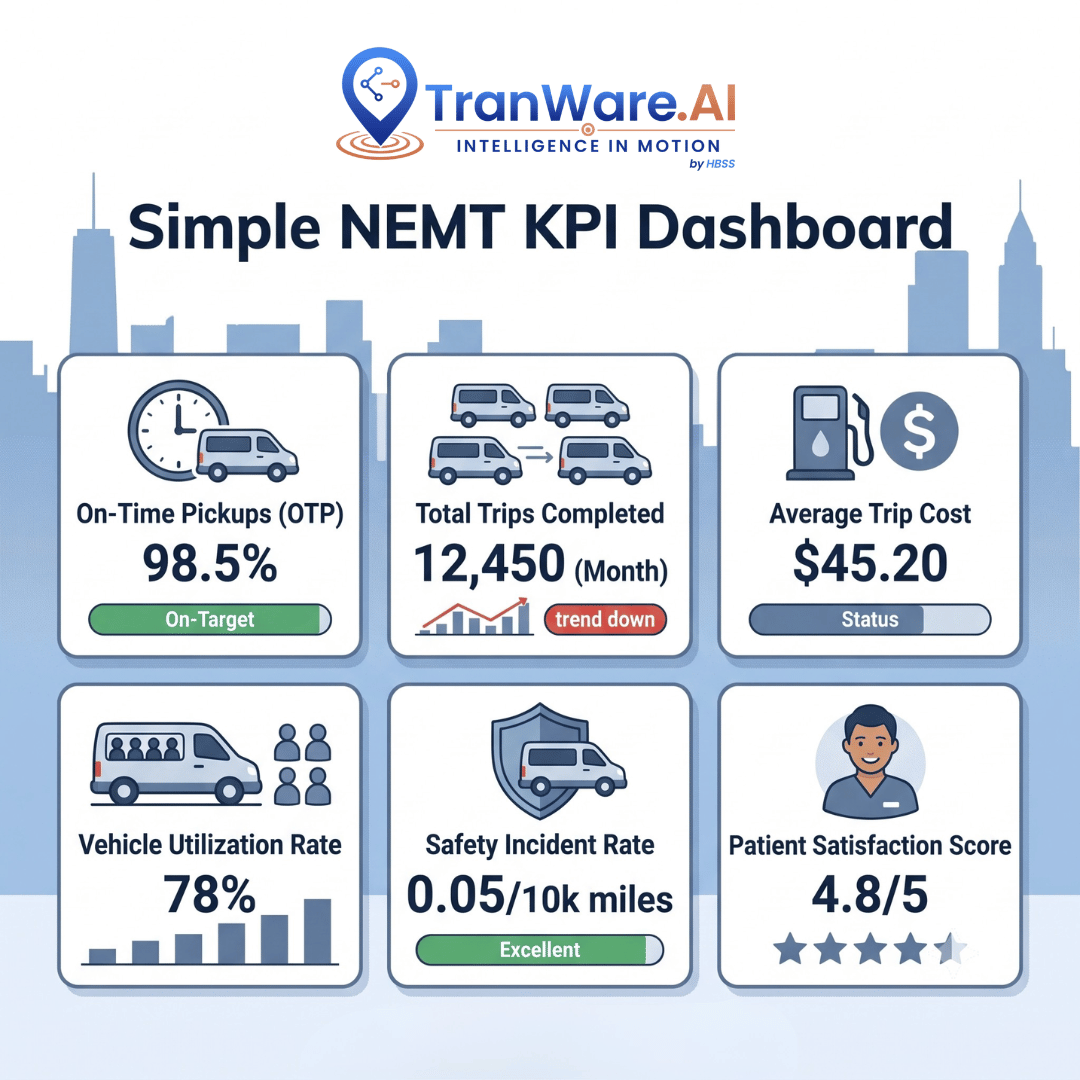
NEMT KPI Dashboard: What Should You Monitor?
A useful NEMT reporting and analytics dashboard should provide both daily operational data and longer-term trends.
At minimum, managers should be able to see:
Daily KPIs
- Total scheduled trips
- Completed trips
- Canceled trips
- No-shows
- On-time percentage
- Active vehicles
- Open trips
- Delayed trips
Weekly KPIs
- Cost per trip
- Vehicle utilization
- Driver productivity
- Average response time
- Billing accuracy
- Claim status
- Complaint trends
Monthly KPIs
- Performance by broker
- Performance by service area
- Vehicle performance
- Route efficiency
- Revenue per trip
- Operating cost trends
- Recurring problem areas
A real-time operations dashboard makes it easier for managers to identify exceptions instead of waiting for month-end reports. TranWare AI currently lists a centralized dashboard for monitoring trips, vehicles, drivers, and fleet performance.
How to Build a Practical NEMT KPI Strategy
Do not try to measure every available number at once. Start with five core KPIs and connect each one to a business goal.
| Business Goal | KPI |
| Improve rider service | On-time performance |
| Reduce missed trips | Completion and no-show rate |
| Improve dispatch operations | Response time |
| Lower operating costs | Cost per trip and utilization |
| Protect revenue | Billing accuracy |
Next, set a baseline using at least several weeks of historical data. Then compare performance by driver, vehicle, route, service type, broker, and location where appropriate.
Most importantly, define each KPI consistently. If one dispatcher counts a trip as late using one rule and another uses a different rule, the resulting report will not provide a reliable picture.
Editor Notes
The best NEMT KPIs are not simply numbers on a dashboard. They show where transportation operations are performing well and where changes are needed.
For most U.S. NEMT providers, five metrics provide a strong starting point:
- On-time performance
- Trip completion and no-show rate
- Response and dispatch time
- Cost per trip and vehicle utilization
- Billing accuracy and revenue cycle performance
The real value comes from connecting these metrics. Late trips can affect complaints. Poor routing can increase costs. Vehicle downtime can reduce trip capacity. Missing documentation can delay payment.
A connected transportation management software platform can help providers monitor these relationships in one place. TranWare AI combines NEMT scheduling software, dispatching, route optimization, GPS tracking, fleet management, mobile applications, billing, payment processing, automated communications, and AI-powered tools to support transportation operations.
For transportation providers looking to improve efficiency, service quality, and operational visibility, the next step is to measure the right KPIs consistently and use the results to improve daily decisions.

FAQs About NEMT KPIs
1. What are the most important NEMT KPIs?
The five key NEMT KPIs are on-time performance, trip completion and no-show rate, response time, cost per trip and vehicle utilization, and billing accuracy.
2. What is a good on-time performance rate for NEMT?
A 95%–99% range can be a reasonable and attainable target for many NEMT performance standards, but the required rate depends on the specific broker contract and service area.
3. How does NEMT dispatch software improve KPI performance?
NEMT dispatch software gives teams real-time visibility into trips, drivers, and vehicles, helping them assign trips, respond to delays, and manage exceptions faster.
4. Why is vehicle utilization important in NEMT?
Vehicle utilization shows how effectively available fleet capacity is being used. Better utilization can reduce idle time, unnecessary mileage, and cost per trip.
5. How can NEMT billing software improve revenue?
NEMT billing software can connect completed trip data with billing and payment workflows, helping reduce manual entry, missing information, billing errors, and payment delays.
Interesting Reads:
How to Manage Transportation Incidents With Incident Tracking Software
5 Best Non-Emergency Medical Transportation (NEMT) Scheduling Software in USA 2026