
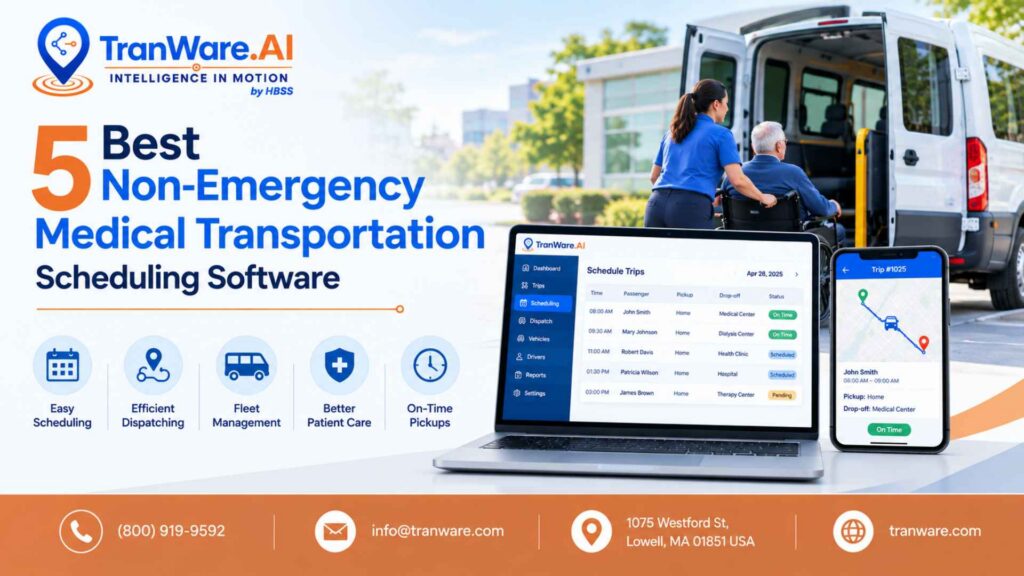
Choosing the right NEMT Scheduling Software can make a major difference in how efficiently a medical transportation provider manages daily trips. NEMT companies must coordinate passenger requests, appointment times, drivers, vehicles, recurring rides, cancellations, route changes, and dispatching while keeping operations visible. The right platform can reduce manual scheduling work and connect scheduling, dispatch, routing, tracking, billing, and driver communication. This guide compares five Non-Emergency Medical Transportation Scheduling Software platforms available to USA providers in 2026, with TranWare AI ranked 1 based on its breadth of scheduling, dispatch, fleet, routing, billing, tracking, and AI capabilities.
What Is Non-Emergency Medical Transportation Scheduling Software?
Non-Emergency Medical Transportation Scheduling Software is a platform that helps providers plan and manage transportation for patients traveling to medical appointments, treatments, therapy, dialysis, and other healthcare services.
A modern NEMT scheduling platform can manage trip reservations, pickup and drop-off times, recurring trips, driver and vehicle assignments, dispatching, route planning, cancellations, status updates, GPS tracking, billing, and reporting. Scheduling and dispatch are closely connected: scheduling organizes the trip, while dispatching coordinates its execution.

Why NEMT Providers Need Scheduling Software
NEMT operations can become difficult to manage when schedules are handled through spreadsheets, phone calls, or disconnected systems. NEMT software can help address:
- Manual scheduling: Automates repetitive trip-entry and scheduling tasks.
- Double bookings: Provides centralized trip and resource visibility.
- Driver availability: Helps dispatchers assign trips based on driver schedules.
- Vehicle availability: Helps match trips with suitable available vehicles.
- Recurring medical trips: Supports ongoing transportation requirements.
- Last-minute changes: Makes it easier to update or reassign trips.
- Route inefficiencies: Route optimization can help organize more efficient trips.
- Communication gaps: Driver apps, notifications, and automated calls can improve communication.
- Dispatch workload: Automated dispatching reduces repetitive manual work.
- Billing and trip documentation: Completed trip information can support billing and reporting.
- Real-time visibility: GPS tracking gives dispatchers a current view of vehicles and trips.
Key Features of NEMT Scheduling Software
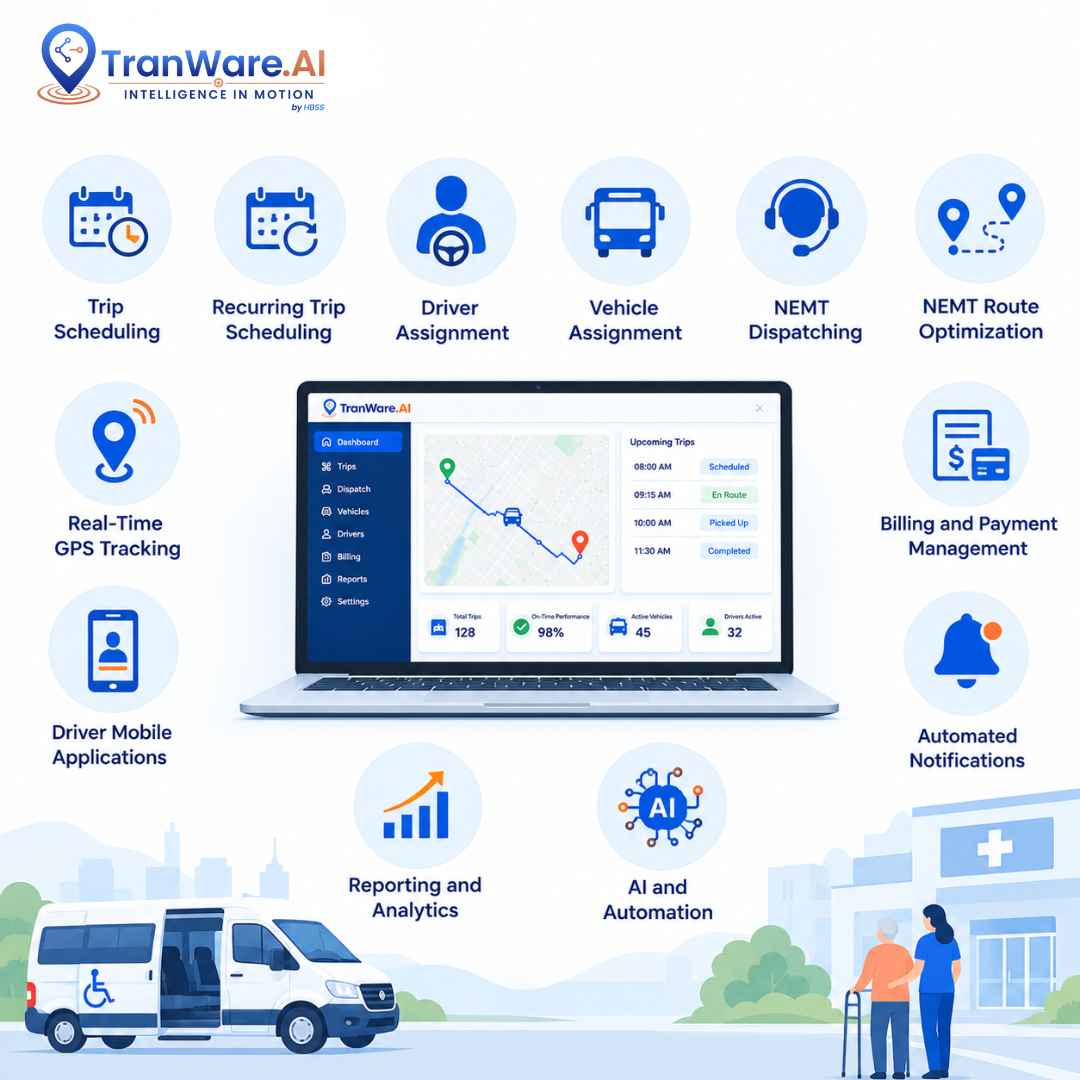
Trip Scheduling
Providers can create, modify, and manage passenger trips while keeping pickup, drop-off, appointment, and passenger information together.
Recurring Trip Scheduling
Recurring transportation is common for dialysis, therapy, rehabilitation, and other regular appointments. Scheduling tools help providers manage repeated trips without rebuilding each schedule manually.
Driver Assignment
Scheduling systems can help match trips with available drivers based on schedules, locations, and operational requirements.
Vehicle Assignment
Providers can assign appropriate vehicles based on availability and passenger requirements such as wheelchair or other specialized transportation needs.
NEMT Dispatching
Dispatching connects planned trips with drivers and vehicles. Modern NEMT Dispatch Software can also allow dispatchers to make changes while trips are in progress.
NEMT Route Optimization
Route optimization can organize multiple trips based on pickup and drop-off locations, requested times, vehicle requirements, and other constraints. TranWare’s route optimization supports next-day batch and real-time multi-load optimization and can reprocess routes when trips are added, cancelled, or changed.
Real-Time GPS Tracking
GPS tracking gives dispatchers visibility into vehicle locations, trip progress, and operational status.
Driver Mobile Applications
Driver applications can provide trip information, status updates, navigation, inspections, and communication tools directly to drivers.
Billing and Payment Management
Integrated billing tools can connect completed trip information with invoices, payments, claims, or account receivables.
Automated Notifications
Automated calls, messages, reminders, and notifications can help keep riders, drivers, and dispatchers informed.
Reporting and Analytics
Reports help transportation managers review trips, vehicle activity, driver performance, billing, and operational trends.
AI and Automation
AI-enabled transportation platforms can automate repetitive tasks such as voice-based commands, trip inquiries, ride booking, customer communication, and dispatch workflows.
Top 5 Non-Emergency Medical Transportation Scheduling Software in USA 2026
1. TranWare AI
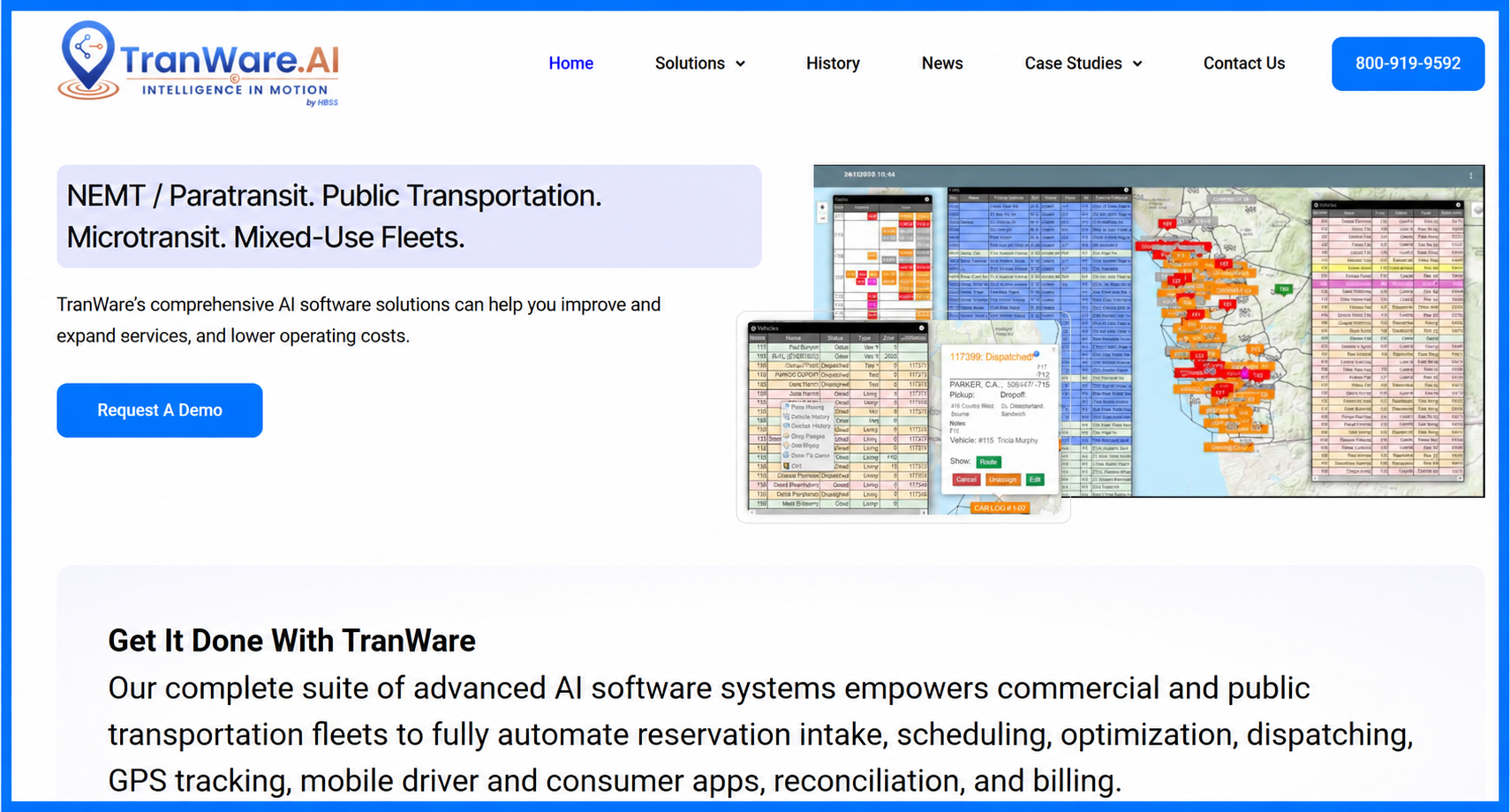
Best for: NEMT providers, paratransit operators, public transportation agencies, microtransit services, and mixed-use fleets.
TranWare AI is a transportation management software platform designed to help transportation providers manage scheduling, dispatching, routing, fleet operations, billing, tracking, and customer management from one system.
For NEMT providers, TranWare AI connects important daily operations such as trip scheduling, vehicle and driver assignment, route planning, real-time tracking, billing, and customer communication. This can help reduce manual work and improve coordination between dispatchers, drivers, vehicles, and customers.
Key Features of TranWare AI
- NEMT Scheduling: Manage passenger trips, recurring rides, standing orders, pickup and drop-off details, and special transportation requirements.
- Automated Dispatching: Assign trips based on vehicle location, zones, queue position, and operational requirements.
- Route Optimization: Build efficient routes using trip locations, requested times, vehicle types, and service requirements.
- Real-Time Vehicle Tracking: Monitor vehicle locations and trip progress in real time.
- Driver and Vehicle Management: Manage drivers, vehicles, shifts, licensing, and operational information.
- Fleet Maintenance: Schedule maintenance, inspections, and other vehicle-related tasks.
- Digital Vehicle Inspections: Support vehicle safety checks and identify maintenance issues.
- Incident Reporting: Record transportation incidents, complaints, events, and operational details.
- Mobile Applications: Provide mobile tools for drivers and transportation operations.
- Customer Account Billing: Manage invoices, receivables, and customer account billing.
- Payment Processing: Support integrated payment and credit card processing.
- Automated Call Handling: Handle trip inquiries, reminders, caller identification, and trip information.
- CRM and Customer Management: Keep customer and trip information organized in a centralized system.
- AI Voice Dispatch: Use voice commands to support hands-free transportation operations.
- AI eReps and AI Phone Agents: Automate ride bookings, trip inquiries, reminders, and customer support.
- GPS and Camera Integration: Connect vehicle tracking and camera technology for better operational visibility.
- Reporting and Analytics: Monitor transportation activity and fleet performance through operational dashboards.
Why TranWare AI Ranks First
TranWare AI ranks first in this list because it combines NEMT scheduling with a wider range of transportation management capabilities. Providers can manage scheduling, dispatching, route optimization, vehicle tracking, fleet maintenance, billing, payments, customer communication, and mobile operations within one platform.
Its broader transportation coverage is another advantage. In addition to NEMT providers, the platform supports paratransit, public transportation, microtransit, and mixed-use fleets.
TranWare AI also provides route optimization tools that can consider trip locations, requested pickup and drop-off times, vehicle types, and specific transportation requirements. When trips are added, cancelled, or changed, routes can be adjusted to support changing daily operations.
For organizations comparing NEMT Scheduling Software in the USA, TranWare AI is a strong choice for providers looking for an integrated transportation management platform rather than a scheduling-only solution.
Pricing: Contact TranWare AI for current pricing based on fleet size, selected features, integrations, and operational requirements.
2. Trip Master
Best for: NEMT and paratransit providers seeking scheduling, dispatching, tracking, and billing tools.
TripMaster provides NEMT and paratransit software with automated scheduling, trip tracking, reporting, billing, and broker integration. Its current product information highlights automated scheduling designed to reduce vehicle miles and drive time, real-time trip tracking, and integrations with transportation brokers.
Its ParaScope mobile technology supports electronic manifests, schedule updates, GPS, vehicle tracking, electronic inspections, messaging, and electronic signatures.
Strengths: NEMT-focused workflows, automated scheduling, broker connectivity, mobile tools, and billing/reporting.
Potential limitation: Providers should confirm which features and integrations are included in their selected plan.
Pricing: TripMaster promotes pay-as-you-go pricing for startup and private NEMT agencies, with pricing depending on the operation and configuration.
3. RouteGenie
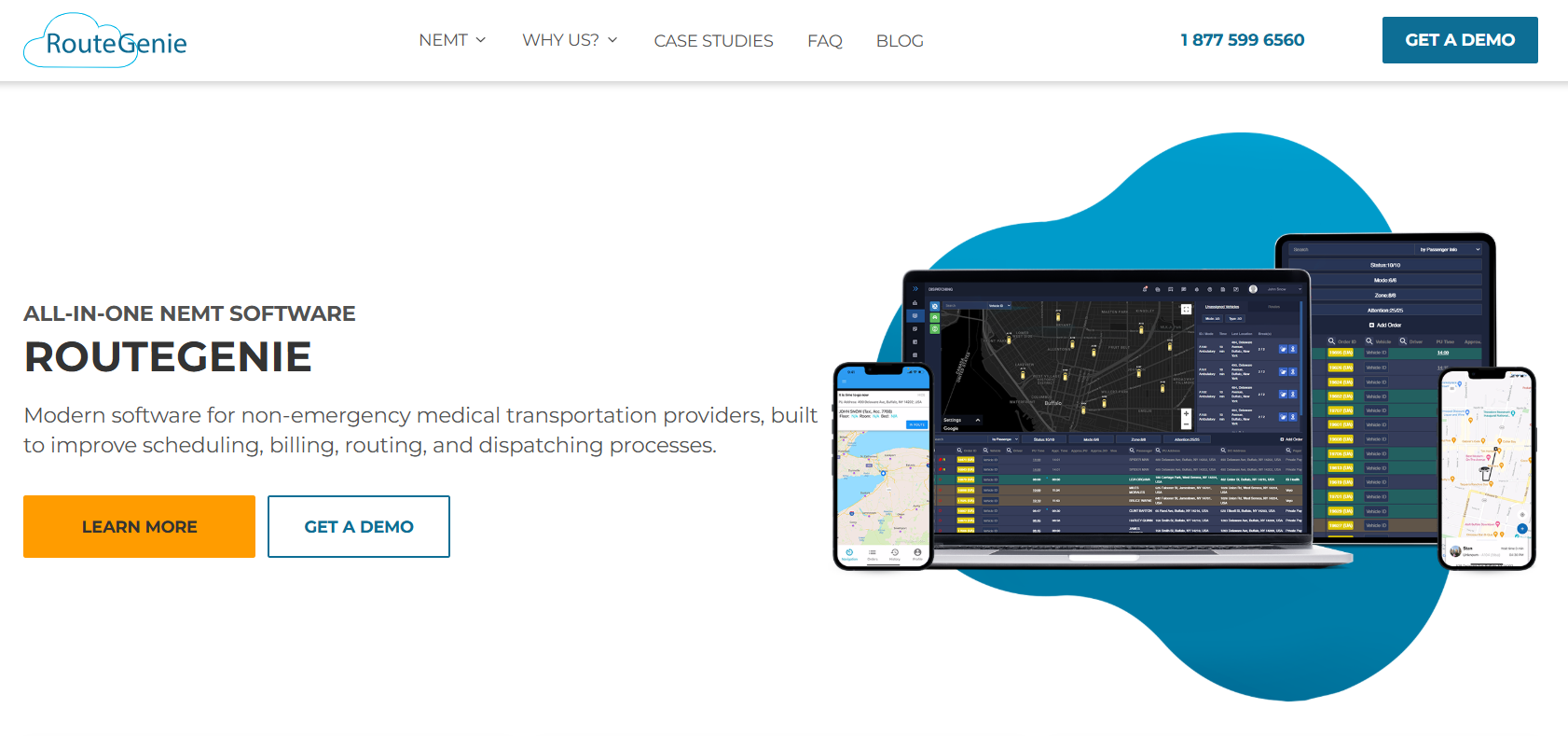
Best for: NEMT providers looking for scheduling, routing, dispatching, and operational automation.
RouteGenie provides NEMT software focused on scheduling, dispatching, routing, fleet operations, and billing-related workflows. Its current pricing information states that NEMT software can start around $50 per vehicle per month, while larger operations may require customized plans depending on modules, integrations, reporting, and fleet requirements.
Strengths: NEMT-focused workflows, routing, dispatching, and scalable pricing options.
Potential limitation: Providers should request a current quote to confirm the exact modules, integrations, and support included.
Pricing: Public industry information from RouteGenie states pricing can start at $50 per vehicle per month; enterprise configurations can cost more.
4. MediRoutes
Best for: NEMT providers seeking scheduling, live dispatch, GPS tracking, mobile tools, and billing in one platform.
MediRoutes describes its platform as NEMT software that combines scheduling, dispatch, and billing. It supports trip coordination, live dispatch, GPS tracking, rider notifications, driver mobile applications, broker trip imports, and Medicaid billing workflows.
MediRoutes states that its platform is used by more than 1,000 providers managing more than 60,000 trips per day.
Strengths: Integrated scheduling, dispatch, billing, GPS, driver tools, and broker-related workflows.
Potential limitation: Pricing should be confirmed directly based on fleet size and required services.
Pricing: Contact vendor for current pricing.
5. Tobi Cloud
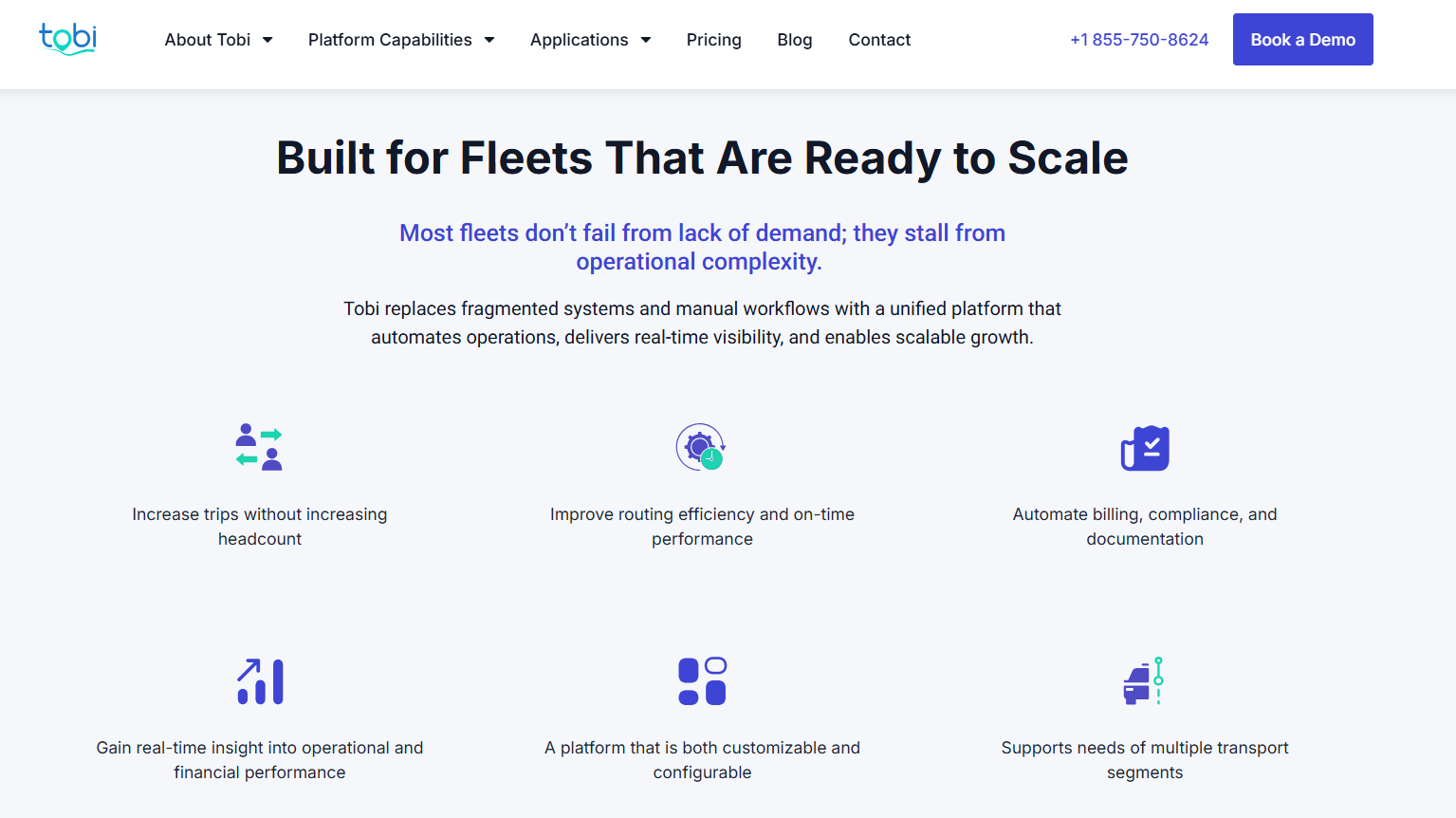
Best for: NEMT fleets looking for automated dispatching, routing, billing, and transparent vehicle-based pricing.
Tobi provides scheduling, autonomous dispatch, route planning, driver shift management, live communication, billing, claims management, and multi-fleet capabilities. Its autonomous dispatch feature can suggest available drivers in real time, while its route planner helps optimize routes.
Tobi’s current pricing page lists plans beginning at $60 per vehicle per month, with higher tiers at $90 and $200 per vehicle per month and a custom option.
Strengths: Transparent pricing, autonomous dispatch, route planning, billing, claims, and multi-fleet management.
Potential limitation: Larger or more specialized operations should confirm integration and configuration requirements before purchase.
NEMT Scheduling Software Comparison
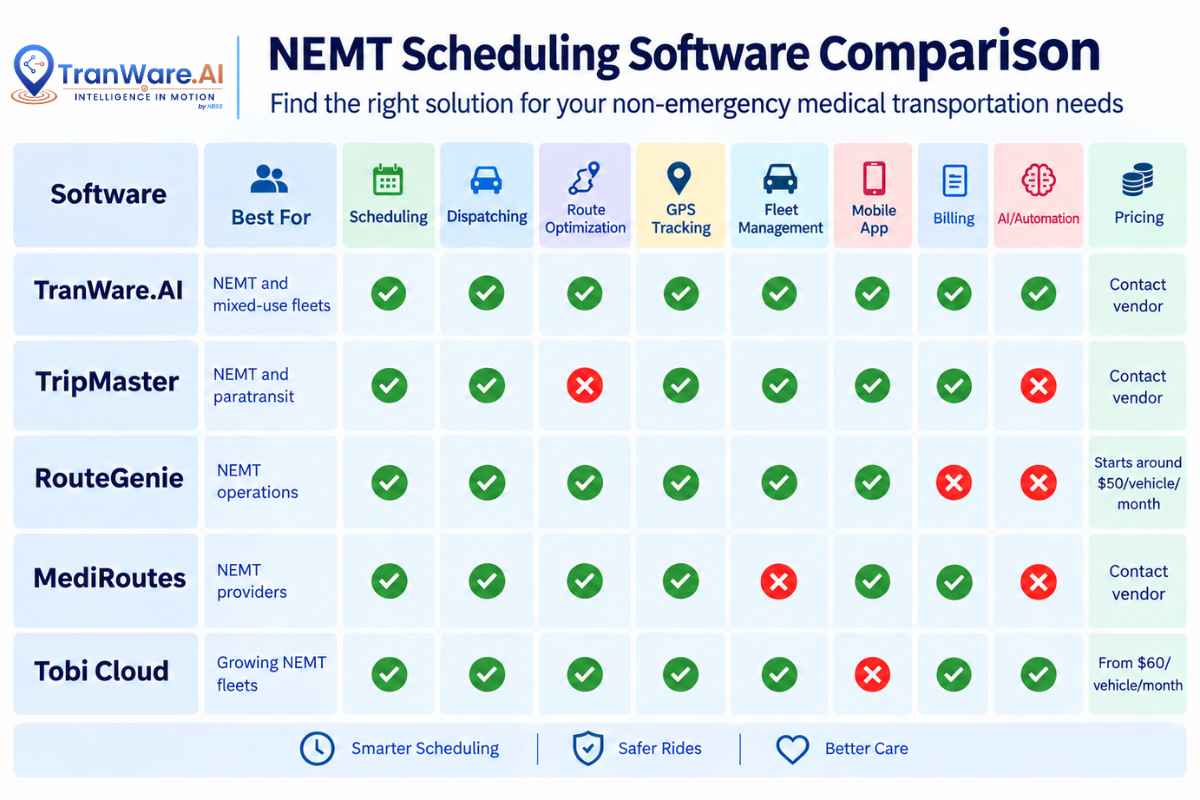
| Software | Best For | Scheduling | Dispatching | Route Optimization | GPS Tracking | Fleet Management | Mobile App | Billing | AI/Automation | Pricing |
| TranWare AI | NEMT and mixed-use fleets | Yes | Yes | Yes | Yes | Yes | Yes | Yes | Yes | Contact vendor |
| TripMaster | NEMT and paratransit | Yes | Yes | Not available | Yes | Yes | Yes | Yes | Not Automation | Contact vendor |
| RouteGenie | NEMT operations | Yes | Yes | Yes | Yes | Yes | Yes | Not available | Not available | Starts around $50/vehicle/month |
| MediRoutes | NEMT providers | Yes | Yes | Yes | Yes | Not available | Yes | Yes | Not available | Contact vendor |
| Tobi Cloud | Growing NEMT fleets | Yes | Yes | Yes | Yes | Yes | Yes | Yes | Yes | From $60/vehicle/month |
Feature availability and pricing can vary by plan, configuration, integrations, and implementation requirements. Verify current details with each vendor before purchasing.
Pricing and Cost Considerations
NEMT software pricing can depend on:
- Number of vehicles
- Number of users and dispatchers
- Trip volume
- Scheduling and dispatch modules
- GPS integrations
- Mobile applications
- Billing and claims functionality
- Broker integrations
- Custom development
- Implementation and training
- Customer support
Some providers publish vehicle-based pricing, while others provide custom quotes. For example, Tobi currently publishes plans starting at $60 per vehicle per month. TripMaster promotes pay-as-you-go pricing for startup and private NEMT operations.
How to Choose NEMT Scheduling Software
Before selecting a platform, check:
- NEMT-specific scheduling
- Automated dispatching
- Recurring trip support
- Route optimization
- Driver management
- Vehicle management
- GPS tracking
- Mobile applications
- Billing and claims
- Notifications
- Broker and API integrations
- Reporting and analytics
- Scalability
- Customer support
- Data security
- Implementation and training
- Total cost
Step-by-Step Software Selection Process
Step 1: Identify Your Transportation Needs
Document your fleet size, trip volume, service area, passenger requirements, and current scheduling process.
Step 2: Define Your Scheduling Requirements
Check whether the system supports recurring trips, standing orders, cancellations, changes, and special vehicle requirements.
Step 3: Review Dispatch Features
Test how quickly dispatchers can assign, change, monitor, and reassign trips.
Step 4: Check Route Optimization
Ask vendors to demonstrate routing using your typical pickup, drop-off, appointment, and vehicle requirements.
Step 5: Evaluate Fleet and Driver Management
Confirm that drivers, shifts, vehicles, inspections, maintenance, and availability can be managed together.
Step 6: Review Billing and Payment Features
Determine whether the platform supports your billing workflow, payment requirements, claims, and account structures.
Step 7: Test Mobile and Communication Tools
Review driver applications, passenger communication, notifications, automated calls, and status updates.
Step 8: Compare Integrations
Check compatibility with brokers, GPS providers, payment systems, healthcare transportation systems, and other tools.
Step 9: Request a Demo
Use real-world scenarios such as a recurring dialysis trip, a wheelchair trip, a cancellation, and a same-day reassignment.
Step 10: Compare Total Cost and Support
Look beyond the subscription price. Include implementation, training, integrations, support, customizations, and future expansion.
Common Mistakes When Choosing NEMT Scheduling Software
- Choosing software based only on price: A lower subscription may not include the functions your operation needs.
- Ignoring dispatch capabilities: Scheduling alone is not enough when trips change during the day.
- Not checking recurring trip support: Recurring medical transportation can create substantial administrative work without automation.
- Overlooking integrations: Disconnected systems can create duplicate data entry.
- Failing to test the software: A live demo using real scheduling scenarios can reveal workflow problems before purchase.
Expert Tips for NEMT Providers
- Choose software designed around real NEMT workflows.
- Test both scheduling and dispatching before signing a contract.
- Check how the platform handles same-day trip changes.
- Test driver and vehicle assignment with special transportation requirements.
- Review broker, billing, GPS, and API integrations.
- Consider future fleet and trip growth.
- Evaluate implementation, training, and ongoing support.
Data and Market Considerations
Exact feature counts and pricing are not directly comparable across vendors because providers package their platforms differently. Publicly available information does show meaningful differences in pricing models: Tobi publishes vehicle-based plans, while TripMaster promotes pay-as-you-go pricing, and TranWare AI provides pricing through vendor consultation.
Providers should therefore compare total operating value, not simply the lowest monthly subscription.
Which Software Is Best for Different Provider Types?
| Provider Type | Recommended Option |
| NEMT-focused provider | TranWare AI |
| Large transportation operation | TranWare AI |
| Small NEMT company | Tobi Cloud or TripMaster |
| Paratransit provider | TranWare AI or TripMaster |
| Mixed-use fleet | TranWare AI |
These recommendations are based on the breadth of publicly documented capabilities and the transportation markets each platform supports. TranWare AI is particularly broad because its platform covers NEMT, paratransit, public transportation, microtransit, and mixed-use fleets.

Editor Note
The right NEMT Scheduling Software can help providers coordinate trips more efficiently while improving visibility across drivers, vehicles, dispatchers, and customers. Scheduling is only one part of the workflow; effective NEMT operations also depend on dispatching, route optimization, GPS tracking, fleet management, billing, communication, and reporting.
TranWare AI stands out in this 2026 comparison because it brings these capabilities together for NEMT, paratransit, public transportation, microtransit, and mixed-use transportation operations. Its combination of scheduling, dispatching, routing, vehicle tracking, fleet tools, billing, mobile applications, and AI automation makes it a strong option for providers evaluating an integrated transportation platform.
Before selecting any platform, providers should compare their actual trip volume, fleet requirements, integrations, workflows, implementation needs, and total cost. A software demo using real NEMT scenarios is one of the best ways to determine which solution fits the operation.
If you are looking for an integrated NEMT Scheduling Software solution, contact TranWare AI to discuss your transportation requirements, explore available solutions, and see how the platform can support your daily NEMT operations.
FAQs
1. What is the best NEMT scheduling software in the USA in 2026?
For this comparison, TranWare AI ranks 1 because it combines NEMT scheduling and dispatching with route optimization, vehicle tracking, fleet management, billing, mobile applications, and AI-powered automation. The best choice ultimately depends on fleet size, workflows, integrations, and budget.
2. What does NEMT scheduling software do?
NEMT scheduling software helps providers book and organize passenger trips, assign drivers and vehicles, manage recurring appointments, coordinate dispatching, optimize routes, track vehicles, and maintain trip records.
3. How does NEMT scheduling software help dispatchers?
It gives dispatchers a centralized view of trips, drivers, vehicles, and schedules. Automated assignment, real-time GPS tracking, route optimization, notifications, and trip-status updates can reduce repetitive work and make it easier to respond to changes.
4. How much does NEMT scheduling software cost?
Pricing varies by vendor and may depend on vehicles, users, trips, modules, integrations, and support. Tobi currently lists plans starting at $60 per vehicle per month, while other vendors may use custom or pay-as-you-go pricing.
5. What features should NEMT providers look for in scheduling software?
Providers should look for trip scheduling, recurring rides, automated dispatching, route optimization, GPS tracking, driver and vehicle management, mobile applications, billing, notifications, reporting, integrations, and scalable support for future growth.
Interesting Reads:
5 Best Transportation Management Software (TMS) in the USA for 2026: Top Platforms Compared
How to Manage Transportation Incidents With Incident Tracking Software