
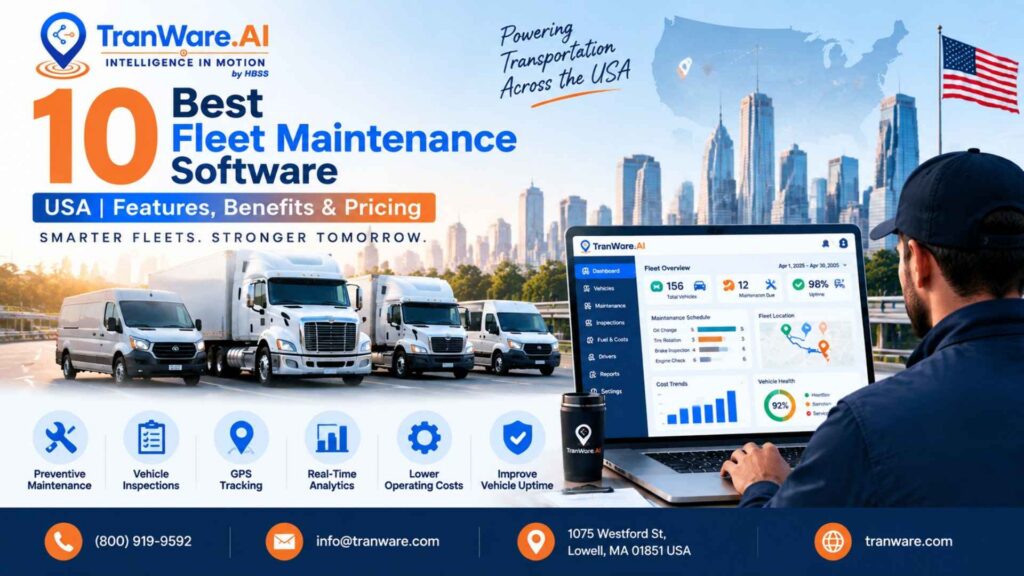
Managing vehicles across a transportation operation requires more than GPS tracking. Fleet managers need to know when vehicles require service, which inspections are complete, what parts are in stock, and how maintenance affects daily operations. Fleet maintenance software brings these tasks into a centralized system and can help transportation companies reduce manual work, improve vehicle readiness, and maintain better service records.
This guide reviews 10 fleet maintenance software and transportation technology platforms used or offered for the U.S. transportation market. The list includes TranWare AI, Coordinated Transportation Solutions, Via Transportation, Ecolane/Transit Technologies, SpareLabs, TripSpark Technologies, RideCo, Moovit, TransLoc, and MTM Health. The platforms differ in their focus, so the right option depends on fleet size, transportation type, maintenance requirements, scheduling needs, and budget.

What Is Fleet Maintenance Software?
Fleet maintenance software is a digital system used to organize and track vehicle maintenance activities. It can help fleet managers schedule preventive maintenance, record inspections, track repairs, manage parts, monitor vehicle history, and create maintenance reports.
Modern fleet management systems may also connect maintenance with scheduling, dispatching, GPS tracking, driver applications, route optimization, and transportation management software. This gives managers a broader view of vehicle availability and helps them make decisions before maintenance problems affect service.
For NEMT, paratransit, public transportation, and microtransit operators, this connection is especially useful. A vehicle that is unavailable for maintenance can affect driver assignments, trip schedules, and passenger service.
What Should Fleet Maintenance Software Include?
Before selecting a fleet maintenance management system, transportation companies should look for features that match their daily operations.
Important capabilities include:
- Preventive maintenance scheduling
- Vehicle service history
- Digital vehicle inspections
- Maintenance reminders
- Work order management
- Parts and inventory tracking
- Vendor management
- Vehicle availability tracking
- GPS and telematics integrations
- Driver and vehicle records
- Maintenance cost reporting
- Compliance documentation
- Mobile access
- Scheduling and dispatch integration
- Reporting and analytics
For NEMT providers, additional capabilities such as NEMT dispatch software, scheduling, GPS tracking, broker integrations, and driver mobile applications can be important.
10 Best Fleet Maintenance Software in the USA
The following list focuses on transportation organizations looking for fleet maintenance capabilities alongside fleet management, scheduling, dispatch, or transit operations.
1. TranWare AI – Best for Integrated Transportation Fleet Management
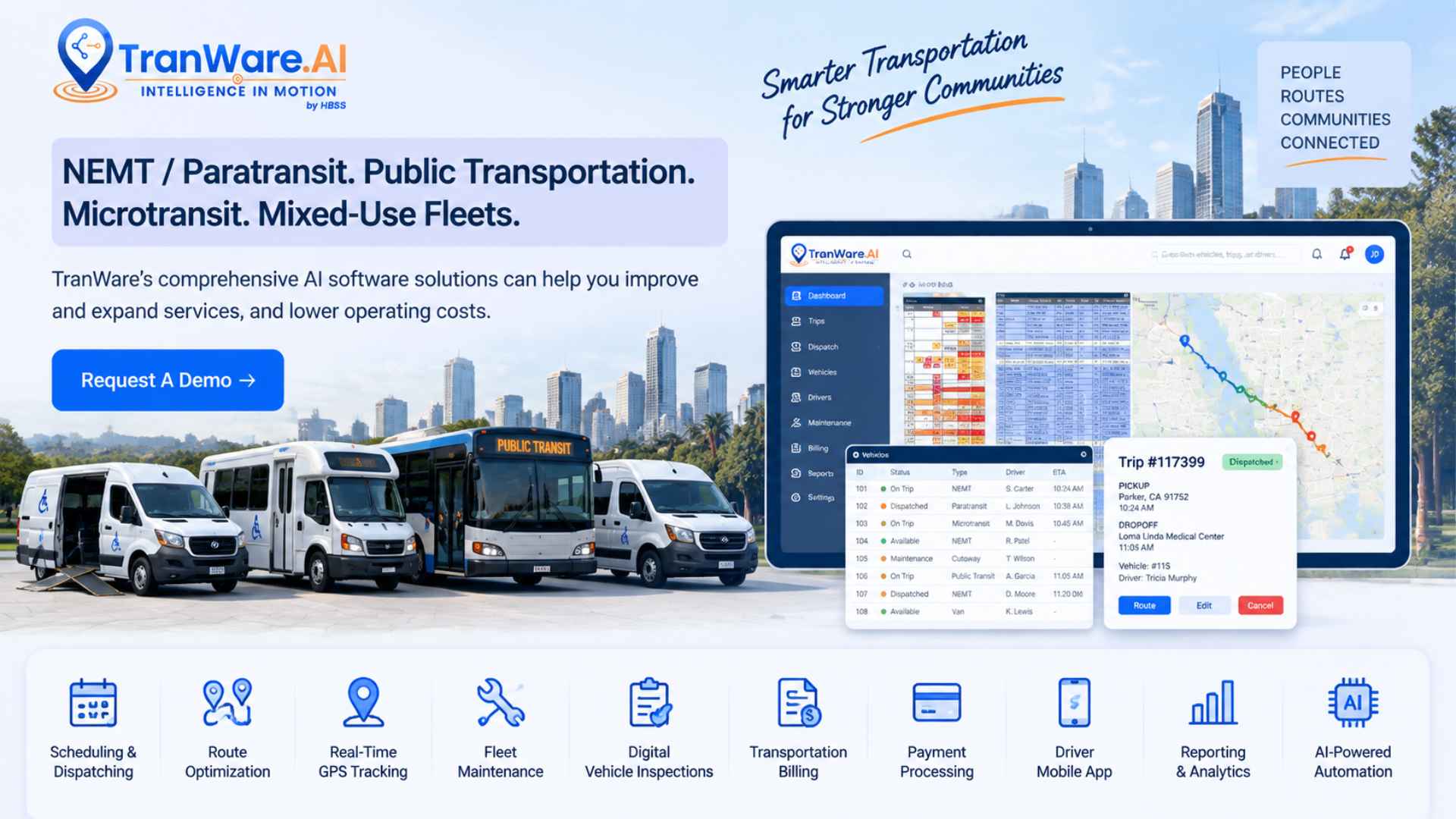
TranWare AI is a transportation management platform designed for NEMT, paratransit, public transportation, microtransit, and other ground transportation operations.
Its fleet maintenance solution supports preventive maintenance schedules based on parameters such as mileage and days in service. Managers can create maintenance schedules for different vehicle types and use detailed task lists for service requirements.
The platform also supports customizable vehicle shift inspections. Drivers can complete required inspection tasks through a mobile application, helping transportation teams record vehicle conditions before service.
Another useful capability is parts management. TranWare supports automated parts ordering based on inventory levels, vehicle and part classification, vendor management, barcode integration, and real-time inventory reporting.
Key Features of TranWare AI
- Preventive Maintenance Scheduling – Manage regular maintenance schedules to help keep vehicles ready for daily operations.
- Digital Vehicle Inspections – Complete digital vehicle inspections and identify maintenance issues earlier.
- Maintenance and Shift Inspections – Track required inspections and maintenance activities across the fleet.
- Inventory Management – Manage fleet-related inventory as part of the maintenance workflow.
- Vehicle Tracking – Monitor the real-time location and status of vehicles.
- Scheduling & Dispatching – Connect fleet maintenance with daily trip scheduling and dispatch operations.
- Route Optimization – Support next-day and real-time multi-load route scheduling and optimization.
- Mobile Applications – Give NEMT and paratransit teams mobile tools for day-to-day fleet operations.
- GPS & Camera Integration – Connect GPS tracking and camera systems for real-time fleet visibility and operational insights.
- Real-Time Operations Dashboard – Monitor trips, vehicles, drivers, and fleet performance from a centralized dashboard.
- NEMT Software Solutions – Bring maintenance, scheduling, dispatching, tracking, and other transportation workflows together for NEMT operations.
Pricing: Contact TranWare for current pricing and deployment details.
Best suited for: NEMT providers, paratransit operators, public transit agencies, microtransit services, and transportation companies that want fleet maintenance connected with broader transportation operations.
2. Coordinated Transportation Solutions – Best for NEMT and Specialized Transportation Operations
Coordinated Transportation Solutions (CTS) is focused on non-emergency transportation, including medical and non-medical transportation services. Its operations support government agencies, managed care organizations, nonprofits, and businesses across the United States.
CTS combines transportation management practices with technology-focused infrastructure. Its service model is particularly relevant to organizations managing transportation for healthcare and specialized populations.
For buyers comparing NEMT software solutions, CTS is worth considering when transportation coordination, mobility management, and healthcare-related transportation are major requirements.
Key areas:
- NEMT operations
- Non-emergency transportation
- Transportation coordination
- Mobility management
- Data collection and analysis
- Specialized transportation services
Pricing: Contact CTS for service-specific pricing.
Best suited for: Healthcare transportation programs, NEMT networks, government transportation programs, and specialized transportation organizations.
3. Via Transportation – Best for Modern Public Mobility Operations
Via Transportation provides software and operational solutions for public transportation, microtransit, paratransit, student transportation, and other mobility programs.
Its platform includes fleet and driver management capabilities. Via’s documented fleet management functionality covers vehicle tracking, driver management, incident reporting, maintenance workflows, compliance monitoring, and shift scheduling.
Via also provides scheduling and routing technology. Its current platform includes AI-supported planning and operations capabilities for fixed-route, paratransit, and microtransit services.
Key features:
- Fleet and driver management
- Maintenance workflows
- Incident reporting
- Compliance monitoring
- Vehicle tracking
- Scheduling
- Routing
- Microtransit management
- Paratransit technology
- Operational analytics
Pricing: Generally quote-based for transportation agencies and operators.
Best suited for: Cities, transit agencies, and transportation organizations operating modern fixed-route, paratransit, or microtransit services.
4. Ecolane / Transit Technologies – Best for Transit and Paratransit Fleet Operations
Ecolane is part of the broader Transit Technologies portfolio and provides transportation technology for fixed-route, paratransit, NEMT, and microtransit operations.
Its fleet-related capabilities include automatic vehicle location, GPS fleet tracking, pre- and post-trip inspections, and vehicle maintenance functionality. Ecolane states that its software can track vehicle maintenance history, fuel usage, and related operational data.
Transit Technologies’ dedicated vehicle maintenance solution adds asset lifecycle tracking, preventive maintenance, warranty tracking, tire tracking, maintenance history, work orders, labor tracking, and parts inventory management.
Key features:
- Preventive maintenance
- Vehicle inspections
- Asset lifecycle tracking
- Warranty tracking
- Tire tracking
- Work orders
- Parts inventory
- GPS and AVL
- Fuel tracking
- Maintenance history
Pricing: Contact the provider for a customized quote.
Best suited for: Public transit agencies, paratransit operators, NEMT organizations, and larger transportation operations.
5. SpareLabs / Spare – Best for Transit Fleet Maintenance and EAM
Spare provides transit technology that connects fleet maintenance with broader transportation operations. Its Spare EAM platform is designed for inspections, work orders, parts, vehicle history, and asset management.
The platform supports digital inspections, work orders, parts and inventory control, vehicle service records, and telematics integrations. It can also use data such as odometer readings and fault codes to support maintenance workflows.
A Spare customer case study involving Gulf Coast Transit District reported 100% technician adoption within 30 days, 20% more inspections completed, more than two hours of administrative work saved daily, and a 15% increase in vehicles available for service. These are reported results from that specific customer case, not a general industry guarantee.
Key features:
- Digital inspections
- Digital work orders
- Preventive maintenance
- Parts management
- Vehicle history
- Telematics integration
- Fleet availability monitoring
- Compliance reporting
- Mobile maintenance workflows
Pricing: Contact Spare for pricing.
Best suited for: Public transit agencies and transportation organizations needing enterprise asset management alongside fleet maintenance.
6. TripSpark Technologies – Best for Paratransit and Public Transit Operations
TripSpark Technologies provides transportation software for fixed-route, paratransit, microtransit, rideshare, and community NEMT operations.
Its platform combines scheduling, routing, dispatching, passenger technologies, and in-vehicle technology. TripSpark reports serving more than 450 agencies and moving more than 511,000 people each day.
Its public transportation software also helps agencies manage schedules, routes, drivers, operational information, and reporting from an integrated environment.
Key features:
- Scheduling
- Dispatching
- Routing
- Paratransit software
- NEMT capabilities
- Microtransit
- In-vehicle technology
- Driver management
- Operational reporting
Pricing: Contact TripSpark for a customized quote.
Best suited for: Mid-sized urban, suburban, and rural transportation agencies and operators in North America.
7. RideCo – Best for Microtransit and On-Demand Fleet Operations
RideCo focuses on on-demand transit, microtransit, and paratransit operations. Its platform combines passenger applications, driver applications, operations management, analytics, and fleet-related tools.
The RideCo Operations Center provides dashboards for transit dispatch teams, including vehicle supply, operator information, vehicle utilization, capacity trends, and performance data.
RideCo also provides fleet partner solutions designed to help transportation operators improve scheduling, dispatching, productivity, and fleet utilization.
Key features:
- Fleet management
- Driver applications
- Dispatching
- Scheduling
- Vehicle utilization
- Operations dashboards
- Data analytics
- Paratransit
- Microtransit
- Flex fleet management
Pricing: Contact RideCo for pricing based on deployment requirements.
Best suited for: Transit agencies, microtransit programs, paratransit operations, and organizations managing on-demand transportation.
8. Moovit – Best for Real-Time Fleet Visibility
Moovit is widely known for passenger-facing transit information, but its business solutions also include tools for transportation agencies and operators.
Moovit TimePro provides real-time vehicle location and fleet management capabilities. It uses a cloud-based architecture and can operate on Android devices without requiring customized hardware. The platform also provides dashboards, real-time ETAs, driver communication, and operational reporting.
For organizations focused on visibility and real-time operations, this can complement a broader fleet management platform.
Key features:
- Real-time vehicle location
- Fleet management
- GPS-based tracking
- Driver communication
- ETA management
- Operational reporting
- Cloud-based platform
- Android driver application
Pricing: Contact Moovit for enterprise pricing.
Best suited for: Public transit agencies and operators that prioritize real-time vehicle visibility and passenger information.
9. TransLoc – Best for GPS Tracking and Transit Fleet Visibility
TransLoc provides fixed-route and on-demand transit technology for agencies, campuses, airports, and other organizations.
Its Vehicle Tracker platform provides real-time vehicle monitoring, historical playback, reporting, alerts, and fleet management capabilities. TransLoc states that its Vehicle Tracker also supports maintenance management and service/mileage reporting.
The platform can connect vehicle tracking with broader fixed-route and on-demand transportation systems.
Key features:
- Real-time vehicle tracking
- GPS fleet management
- Historical vehicle playback
- Maintenance reports
- Mileage tracking
- Alerts
- Fixed-route technology
- On-demand transportation
- Driver applications
Pricing: Contact TransLoc for current pricing.
Best suited for: Transit agencies, universities, campuses, airports, and organizations managing fixed-route or on-demand fleets.
10. MTM Health – Best for Healthcare Transportation Management
MTM Health operates in the non-emergency medical transportation market and uses proprietary technology to manage NEMT operations.
Its MTM Link platform supports trip scheduling, routing, dispatching, provider assignment, GPS-enabled tracking, and transportation management. MTM states that its technology provides real-time visibility into NEMT performance and uses cloud-based dispatch and GPS tracking.
MTM Health also acquired Reveal, a routing, scheduling, and dispatching technology platform, to support its NEMT transportation management capabilities.
Key features:
- NEMT scheduling
- Routing
- Dispatching
- GPS tracking
- Provider management
- Trip management
- Real-time transportation visibility
- Member applications
- Transportation analytics
Pricing: Contact MTM Health for service and partnership information.
Best suited for: Healthcare organizations, Medicaid and Medicare transportation programs, NEMT providers, and transportation networks.

Fleet Maintenance Software Comparison
| Software | Primary Focus | Maintenance / Fleet Capability | Pricing |
| TranWare AI | NEMT, paratransit, transit, mixed fleets | Preventive maintenance, inspections, parts, inventory, reporting | Contact vendor |
| Coordinated Transportation Solutions | NEMT and specialized transportation | Transportation coordination and management | Contact vendor |
| Via Transportation | Public transit, microtransit, paratransit | Fleet/driver management, maintenance workflows, compliance | Contact vendor |
| Ecolane / Transit Technologies | Transit, paratransit, NEMT | Maintenance, inspections, asset lifecycle, parts | Contact vendor |
| Spare | Transit EAM | Work orders, inspections, parts, vehicle history | Contact vendor |
| TripSpark | Fixed route, paratransit, NEMT | Integrated transportation and vehicle operations | Contact vendor |
| RideCo | Microtransit and paratransit | Fleet, driver and operations management | Contact vendor |
| Moovit | Transit visibility | Real-time fleet tracking and reporting | Contact vendor |
| TransLoc | Fixed route and on-demand transit | GPS, mileage, maintenance reporting | Contact vendor |
| MTM Health | NEMT | Routing, dispatch, GPS and transportation management | Contact vendor |
Pricing changes by fleet size, modules, integrations, implementation, and contract structure. Most enterprise transportation platforms listed above use customized pricing rather than publishing a standard monthly rate.
How to Choose Fleet Maintenance Software
Choosing the right fleet maintenance software requires looking beyond the number of features.
Step 1: Define Your Fleet
Document:
- Number of vehicles
- Vehicle types
- Number of locations
- Average daily trips
- Fleet age
- Maintenance staff
- Drivers and dispatchers
- NEMT or transit requirements
Step 2: Identify Maintenance Problems
Look for the biggest gaps in your current process.
Are inspections still paper-based? Are service reminders missed? Do technicians lack vehicle history? Are parts difficult to track? Do dispatchers know when vehicles are unavailable?
Your answers should guide the software requirements.
Step 3: Check Preventive Maintenance
The system should support maintenance based on factors such as:
- Mileage
- Time
- Engine hours
- Vehicle type
- Service intervals
- Inspection results
Step 4: Review Integration Options
For larger transportation operations, check whether the platform connects with:
- GPS trackers
- Telematics
- Scheduling systems
- Dispatch software
- Driver mobile applications
- Fuel systems
- Accounting platforms
- Transportation management software
Step 5: Request a Demo
Before purchasing, ask vendors to demonstrate a real maintenance workflow. For example, ask them to show how a failed inspection becomes a maintenance task and how the vehicle’s availability is communicated to operations.
Key Factors to Compare
When evaluating fleet management systems, consider:
- Fleet size: Can the platform support your current and future vehicles?
- Maintenance workflows: Can you create preventive maintenance schedules?
- Inspections: Are digital pre-trip and post-trip inspections available?
- Mobile access: Can drivers and technicians update information from the field?
- Inventory: Can the system track parts and reorder levels?
- GPS: Can it connect with your existing GPS tracker for fleet management?
- Reporting: Can managers monitor maintenance costs and vehicle status?
- Integrations: Can it connect to TMS software, dispatch, billing, and telematics?
- Scalability: Can the platform support additional locations and vehicles?
- Support: What onboarding and technical support are included?
Common Fleet Maintenance Software Mistakes
1. Choosing Software Based Only on GPS
GPS is useful, but vehicle location does not replace preventive maintenance, inspections, work orders, and service history.
2. Ignoring Mobile Use
If drivers and technicians cannot easily update information from the field, data may remain incomplete.
3. Not Checking Integration Requirements
A fleet maintenance platform should fit into the existing transportation technology environment rather than creating another isolated database.
4. Focusing Only on Price
The lowest subscription price may not represent the lowest total cost. Consider implementation, training, integrations, hardware, support, and additional modules.
5. Forgetting Future Growth
A system that works for 20 vehicles may not work as well when the fleet reaches 100 or 500 vehicles. Check scalability before signing a long-term contract.
Expert Tips for Fleet Managers
A good fleet maintenance program should be preventive rather than reactive.
Set service schedules before vehicles reach their maintenance limits. Connect inspection results with work orders when possible. Track recurring failures by vehicle so managers can identify patterns. Review maintenance costs by vehicle, not only as a fleet-wide total.
For NEMT and paratransit providers, connect maintenance information with scheduling and dispatch. If a vehicle is removed from service, dispatch should know quickly so another vehicle can be assigned.
Also, measure a few simple KPIs every month:
- Vehicle availability rate
- Preventive maintenance completion rate
- Number of unscheduled repairs
- Average repair time
- Maintenance cost per vehicle
- Maintenance cost per mile
- Number of failed inspections
- Vehicle downtime
These metrics can give fleet managers a clearer view of operational performance.

Conclusion
The best fleet maintenance software depends on the type of transportation operation you manage. A public transit agency may prioritize asset management and inspections, while an NEMT provider may need maintenance connected with scheduling, dispatch, GPS tracking, billing, and driver applications.
The 10 platforms in this guide cover different areas of transportation technology. TranWare AI combines fleet maintenance with broader transportation management capabilities, while platforms such as Spare, Ecolane/Transit Technologies, Via, TripSpark, RideCo, Moovit, and TransLoc address different combinations of transit, fleet, scheduling, dispatch, and operational needs. CTS and MTM Health are particularly relevant to healthcare and specialized transportation environments.
Before choosing a platform, compare your fleet size, maintenance workflow, inspection process, integrations, reporting requirements, mobile needs, and total cost. A well-matched fleet maintenance management system can turn vehicle maintenance from a reactive task into a more organized and measurable part of daily fleet operations.
Frequently Asked Questions
1. What is fleet maintenance software?
Fleet maintenance software is a digital system that helps transportation companies schedule preventive maintenance, manage inspections, record repairs, track parts, and maintain vehicle service histories.
2. What features should fleet maintenance software have?
Important features include preventive maintenance scheduling, inspections, work orders, service history, parts inventory, maintenance reporting, mobile access, and integrations with GPS or telematics systems.
3. Is fleet maintenance software useful for NEMT companies?
Yes. NEMT operators can use fleet maintenance software to manage vehicle inspections, service schedules, vehicle availability, repairs, parts, and maintenance records alongside scheduling and dispatch operations.
4. How much does fleet maintenance software cost?
Pricing varies by fleet size, features, integrations, implementation, and contract terms. Many transportation-focused platforms use customized quotes instead of public pricing.
5. Can fleet maintenance software integrate with GPS tracking?
Many modern platforms can integrate with GPS or telematics systems. These integrations can provide information such as vehicle location, mileage, fault codes, and other operational data that can support maintenance workflows.
Interesting Reads:
5 Best Transportation Management Software (TMS) in the USA for 2026: Top Platforms Compared
TranWare AI: The Complete Guide to Smart NEMT, Paratransit and Fleet Management Solutions