
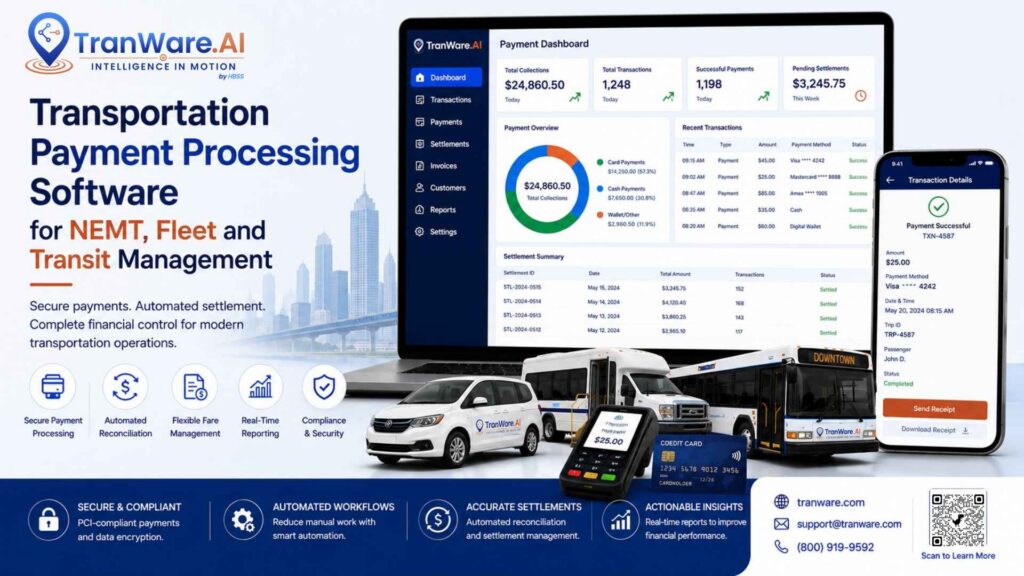
Transportation Payment Processing Software helps transportation providers manage payments, billing, claims, invoices, and financial records from one connected system. For NEMT providers, paratransit operators, and fleet-based transportation companies, the right payment system can reduce manual work and make transactions easier to track. NEMT Payment Processing Software can help NEMT providers simplify payment management and maintain better financial visibility. This guide explains how transportation payment processing works, key features to consider, and how integrated payment tools connect with dispatch, billing, fleet, and customer management. Transportation Payment Processing Software can also support a more connected payment workflow.

What Is Transportation Payment Processing Software?
Transportation Payment Processing Software is a digital solution that helps transportation companies manage payments, billing, invoices, transactions, and financial records in one place. TranWare AI provides this software to help transportation companies manage payment activities alongside daily transportation workflows, making it easier to track revenue and reduce manual administrative work.
Key capabilities can include:
- Credit and debit card payment processing
- Customer billing and invoicing
- NEMT claims and payment workflows
- Trip and fare records
- Fleet related transactions
- Dispatch and transportation management
- Customer account management
- Payment tracking and reconciliation
- Financial reports and analytics
For NEMT and paratransit providers, payment processing can be connected directly with trip information. When a trip is completed, relevant trip and customer details can support the billing and payment process. This creates a connected workflow between scheduling, dispatch, trip completion, billing, claims, and payment collection.
For fleet based transportation companies, payment processing can also work alongside fleet management software. This gives teams a more complete view of customers, vehicles, drivers, trips, billing, and financial transactions without relying on multiple disconnected systems.
Key Benefits of Transportation Payment Processing Software
A well-designed payment platform can provide several operational benefits:
- Faster payment collection: Reduce manual payment entry and repetitive administrative tasks.
- Centralized financial information: Keep billing and payment records in one place.
- Better transaction tracking: Connect payments with customers, trips, invoices, or accounts.
- Reduced data entry: Minimize duplicate information across multiple systems.
- Improved reporting: Generate reports for revenue, payments, outstanding balances, and transactions.
- Better customer experience: Provide convenient payment options such as credit and debit cards.
- Stronger operational visibility: Connect payment information with dispatch and transportation activity.
- Scalable operations: Support growing trip volumes without increasing manual financial work at the same rate.
How Transportation Payment Processing Software Works
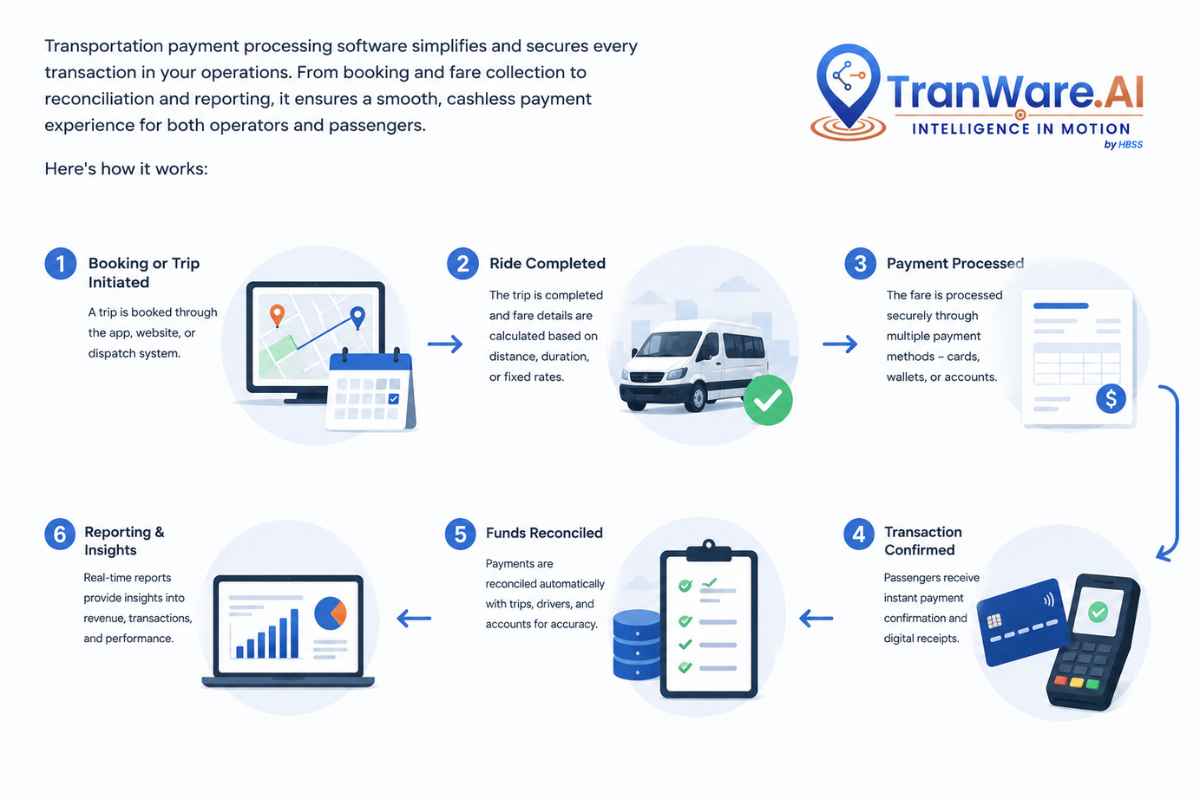
The payment process usually follows a simple sequence.
1. Trip or Service Is Created
A trip is scheduled through dispatch and scheduling software. Information such as the customer, pickup, destination, vehicle, driver, service type, and trip status can be recorded.
2. Service Is Completed
Once the transportation service is completed, the system records the trip as completed and uses the available trip information for billing or payment processing.
3. Billing Information Is Generated
Depending on the business model, the system can generate a customer charge, invoice, fare record, or claim-related information.
4. Payment Is Processed
The customer, payer, organization, or other responsible party can complete payment through an available payment method.
5. Transaction Is Recorded
The completed payment is recorded against the appropriate customer, trip, invoice, or account.
6. Reports Are Updated
Management can use reporting tools to monitor collected payments, outstanding balances, transaction activity, and other financial metrics.
This connected workflow is particularly useful when payment information needs to match operational transportation data.
Transportation Payment Processing for NEMT Providers
NEMT organizations often manage high volumes of scheduled trips involving patients, healthcare organizations, brokers, drivers, and transportation providers.
That makes NEMT Payment Processing Software valuable because financial activity can be connected to the transportation services being delivered.
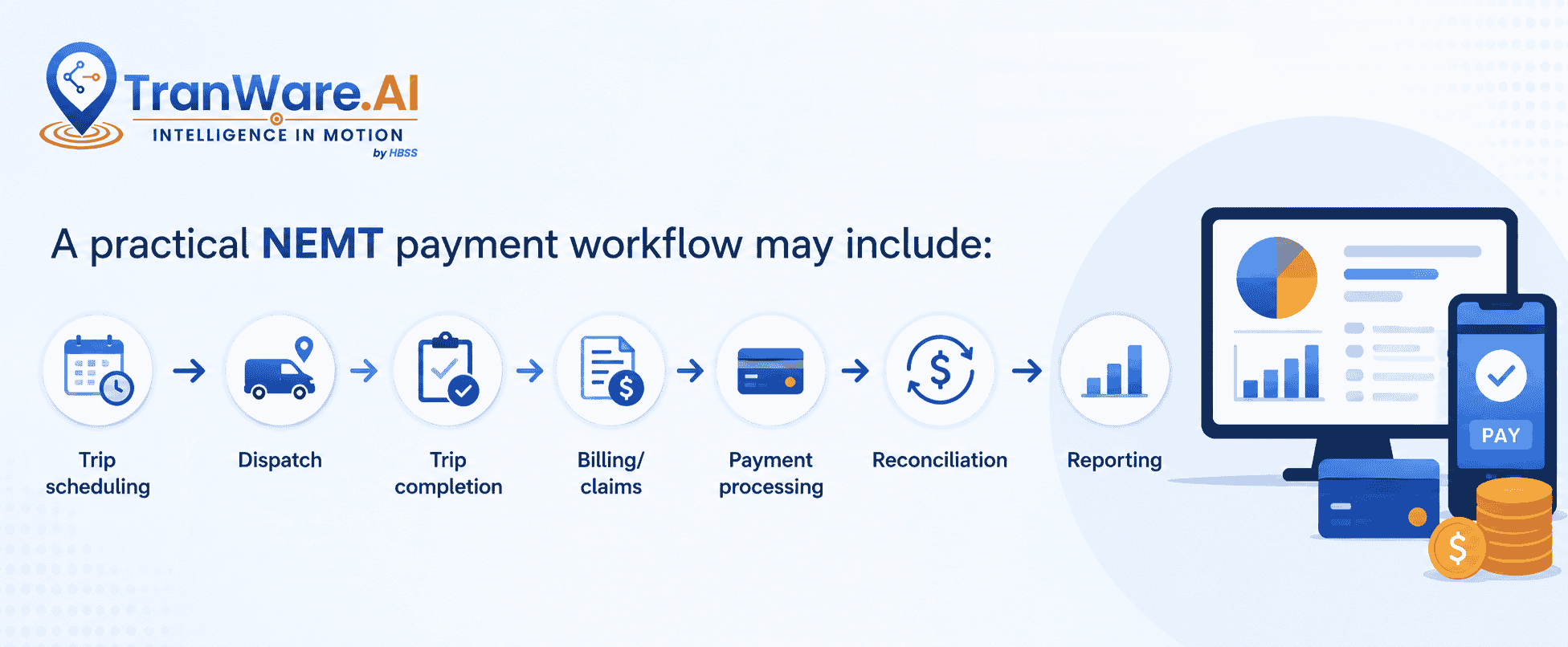
A practical NEMT payment workflow may include:
Trip scheduling → Dispatch → Trip completion → Billing/claims → Payment processing → Reconciliation → Reporting
When these stages are disconnected, staff may need to move information between different applications. An integrated approach can reduce that administrative burden.
Benefits for NEMT Operations
NEMT payment processing can help providers:
- Track trip-related billing information
- Manage customer accounts
- Process eligible payment methods
- Reduce manual billing tasks
- Maintain transaction records
- Connect payment information with completed trips
- Monitor outstanding balances
- Improve financial reporting
The exact workflow depends on the provider’s contracts, payer arrangements, billing model, and payment infrastructure.
Credit Card Payment Processing for Transportation
Credit Card Payment Processing for Transportation gives customers a convenient way to pay for eligible transportation services.
For example, a transportation provider may allow an authorized customer to pay a transportation charge using a credit or debit card. The transaction can then be associated with the relevant account or invoice.
A transportation payment solution should also provide appropriate controls for protecting payment information. Businesses should evaluate their payment processor, security controls, access permissions, and compliance responsibilities before implementation.
Fleet Payment Processing Software
Fleet Payment Processing Software focuses on financial transactions connected to fleet operations.
Depending on the system, fleet-related payment workflows may include:
- Customer payments
- Transportation charges
- Driver-related transactions
- Service billing
- Account balances
- Operational expenses
- Transaction reporting
The key benefit is having payment information available alongside transportation and fleet records rather than managing financial information separately.
For larger transportation businesses, connecting payment workflows with fleet management software can improve operational visibility.
Integrated Payment Processing System
An Integrated Payment Processing System connects payment functionality with other transportation applications.
Instead of operating as an isolated payment tool, it can work with:
- Scheduling and dispatch
- Customer relationship management
- Billing and claims
- Fleet management
- Driver applications
- Vehicle tracking
- Reporting and analytics
- Customer notifications
This integration matters because transportation payments rarely exist independently from transportation services.
For example, if a customer pays for a completed trip, the business needs to know which customer, service, trip, and invoice the payment relates to. Integration helps maintain that relationship between operational and financial records.
Transportation Billing and Payment Software: Key Features
When comparing Transportation Billing and Payment Software, consider the following capabilities.
Payment Management
Look for support for relevant payment methods and transaction tracking.
Customer Account Management
The system should make it easy to view customer accounts, balances, invoices, and payment history.
Billing Integration
Billing should connect with trip and service information whenever possible.
Reporting and Analytics
Useful reports may include:
- Payment activity
- Revenue summaries
- Outstanding balances
- Transaction history
- Customer payment activity
- Billing status
Dispatch Integration
Connecting payment information with dispatch can reduce the need to manually match financial records with transportation trips.
Fleet Integration
Fleet-related data can provide additional operational context for transportation transactions.
Role-Based Access
Different employees should receive access based on their responsibilities. Financial information should not automatically be available to every system user.
Data and Cost Considerations
The cost of transportation payment processing varies significantly because payment processing typically involves both software and transaction-related costs.
| Cost Factor | Typical Consideration |
| Software subscription | Monthly or annual platform fee |
| Payment processing | Usually based on transaction value and/or transaction type |
| Implementation | One-time configuration, integration, and training costs |
| Customization | Additional cost for specialized workflows |
| Hardware | May apply when physical payment devices are required |
| Support | Included in some plans or charged separately |
| Integration | Depends on existing billing, dispatch, accounting, or payment systems |
Important: There is no single universal price for transportation payment processing software. Actual costs depend on transaction volume, features, integrations, payment provider terms, and implementation requirements. Businesses should request a customized quote rather than relying on a generic industry price.
Transportation Payment Processing Software vs. Standalone Payment Tools
| Feature | Standalone Payment Tool | Integrated Transportation Platform |
| Payment collection | Yes | Yes |
| Customer accounts | Limited or varies | Typically integrated |
| Trip information | Usually separate | Connected |
| Dispatch integration | Limited | Stronger potential integration |
| Billing workflow | Separate or limited | Integrated |
| Fleet information | Usually separate | Can be connected |
| Transportation reporting | Limited | More comprehensive |
| Data duplication | Higher risk | Lower when properly integrated |
| Operational visibility | Payment-focused | Transportation-wide |
A standalone payment processor can be useful for basic transactions. However, organizations with complex transportation workflows may benefit more from an integrated platform.
How to Choose the Right Transportation Payment Processing Software
Step 1: Define Your Payment Workflow
Document how money moves through your business.
Identify:
- Who pays?
- What triggers billing?
- Which payment methods are needed?
- How are refunds handled?
- How are transactions reconciled?
- What reports are required?
Step 2: Map Your Transportation Workflow
Review how payment information connects to scheduling, dispatch, trip completion, customer accounts, and billing.
Step 3: Identify Required Integrations
Check whether the software can integrate with the systems your organization already uses.
Step 4: Evaluate Security and Compliance
Ask vendors how payment information is handled, protected, stored, and transmitted. Confirm that the payment architecture supports your organization’s applicable security and compliance requirements.
Step 5: Review Reporting
Request examples of financial and operational reports before purchasing.
Step 6: Test the User Experience
Have dispatchers, billing staff, managers, and other relevant employees test the platform. A system that is technically powerful but difficult to use can create new operational problems.
Step 7: Compare Total Cost
Consider software fees, processing costs, implementation, customization, training, support, and integration expenses.
Requirements and Selection Criteria
Before choosing a transportation payment solution, evaluate:
- Payment processing capabilities
- NEMT billing requirements
- Customer account management
- Billing and claims integration
- Dispatch integration
- Fleet management integration
- Reporting and analytics
- User permissions
- Data security
- Scalability
- Mobile access
- API or integration options
- Customer support
- Implementation requirements
- Total cost of ownership
For organizations already using transportation management software, integration should be one of the highest priorities.
Common Mistakes to Avoid
1. Choosing a Payment Tool Without Considering Dispatch
Payments are connected to transportation activity. Ignoring dispatch integration can create unnecessary manual work.
2. Focusing Only on Transaction Fees
The lowest processing fee does not always mean the lowest total cost. Implementation, support, integrations, and staff time also matter.
3. Ignoring Reporting
Poor reporting can make it difficult to identify outstanding balances, payment trends, or reconciliation problems.
4. Overlooking Security
Payment information requires careful handling. Ask detailed questions about security, access controls, and the payment provider’s responsibilities.
5. Buying More Software Than You Need
A complex platform can create unnecessary costs and training requirements. Match features to actual business needs.
Expert Tips for Better Transportation Payment Management
- Connect payment data to transportation data. A payment record is more useful when staff can understand which account, invoice, or service it relates to.
- Automate repetitive tasks. Identify manual activities that occur every day and determine which can be automated.
- Build around the customer journey. Payment should fit naturally into scheduling, service delivery, billing, and account management.
- Measure financial performance. Track payment activity, outstanding balances, transaction volume, and reconciliation issues.
- Plan for growth. Choose a platform that can handle increasing trips, customers, vehicles, and transactions without requiring a complete system replacement.
- Prioritize integration. If you already use dispatch, fleet, billing, or CRM software, verify how the payment system will exchange data before signing a contract.
How TranWare Can Support Transportation Payment Workflows
TranWare provides transportation management software designed for NEMT providers, paratransit operators, public transit agencies, microtransit services, and mixed-use fleets.
Its transportation technology can bring important operational functions together, including scheduling and dispatch, route optimization, customer management, billing, payment processing, fleet maintenance, vehicle tracking, driver applications, and reporting.
For transportation organizations evaluating Transportation Payment Processing Software, an integrated approach can help connect financial workflows with the daily transportation operations that generate those transactions. Best NEMT Software can also help providers bring essential transportation, payment, billing, and management functions together within a connected platform.
Organizations can also evaluate whether TranWare’s broader platform fits their requirements for NEMT payment processing software, dispatch, route optimization, fleet management, billing, and related transportation workflows.

Conclusion
Transportation Payment Processing Software can do more than process transactions. The strongest solutions connect payments with the transportation activities that create those transactions, including scheduling, dispatch, trip completion, billing, customer accounts, and fleet operations.
For NEMT and other transportation providers, an Integrated Payment Processing System can reduce duplicate data entry, improve financial visibility, and create a more connected workflow. When evaluating options, focus on integration, security, reporting, usability, scalability, and total cost rather than payment processing fees alone.
For transportation organizations looking to connect payment processing with dispatch, billing, fleet management, and other operational functions, TranWare AI provides a broader transportation management platform designed around modern fleet and transportation operations.
FAQs About Transportation Payment Processing Software
1. What is Transportation Payment Processing Software?
It is software that helps transportation businesses manage payment collection, billing, transaction records, customer accounts, and financial reporting.
2. What is NEMT Payment Processing Software?
NEMT Payment Processing Software supports payment and billing workflows associated with non-emergency medical transportation services and can connect financial records with transportation trips.
3. Can transportation payment software integrate with dispatch?
Yes. Depending on the platform, payment workflows can connect with scheduling, dispatch, trip completion, customer accounts, and billing systems.
4. Is credit card processing important for transportation companies?
It can provide customers with a convenient payment option and reduce manual payment handling when properly integrated into the transportation workflow.
5. What should transportation companies look for in payment software?
Look for payment capabilities, billing integration, customer accounts, reporting, security, scalability, dispatch and fleet integration, support, and a total cost that fits the organization’s needs.
Interesting Reads:
Transportation Mobile App for Fleet NEMT and Paratransit Operations
Best Vehicle Tracking Software: Features, Benefits and Uses in 2026