
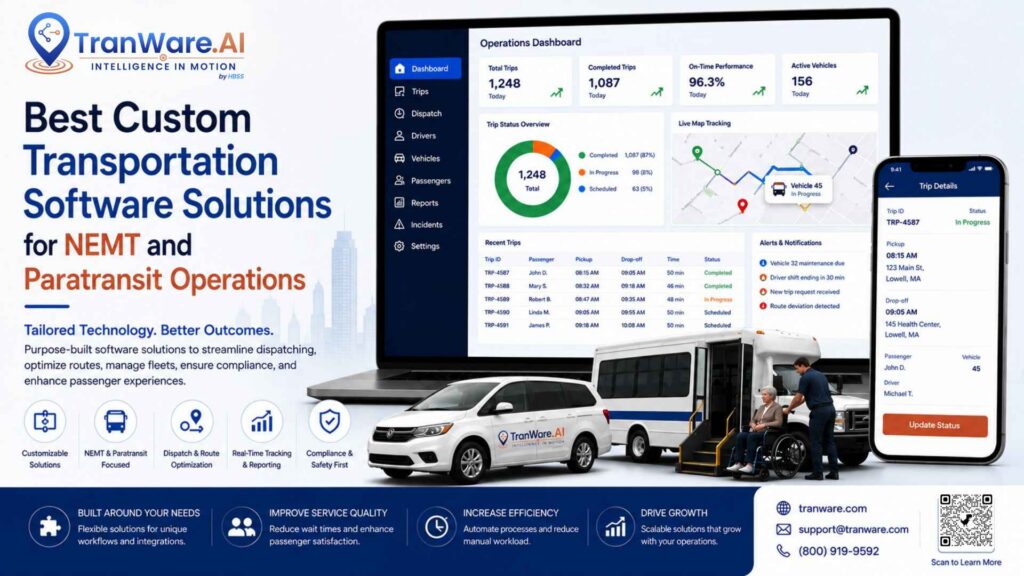
Transportation companies often have different workflows, fleet sizes, customer requirements, and reporting needs. Custom Transportation Software Solutions help organizations build or configure technology around those specific needs instead of forcing operations into a one-size-fits-all system. This guide explains how custom transportation software works, what features to consider, how integrations and automation improve operations, and how to evaluate a solution for NEMT, paratransit, public transit, and mixed-use fleets.

What Are Custom Transportation Software Solutions?
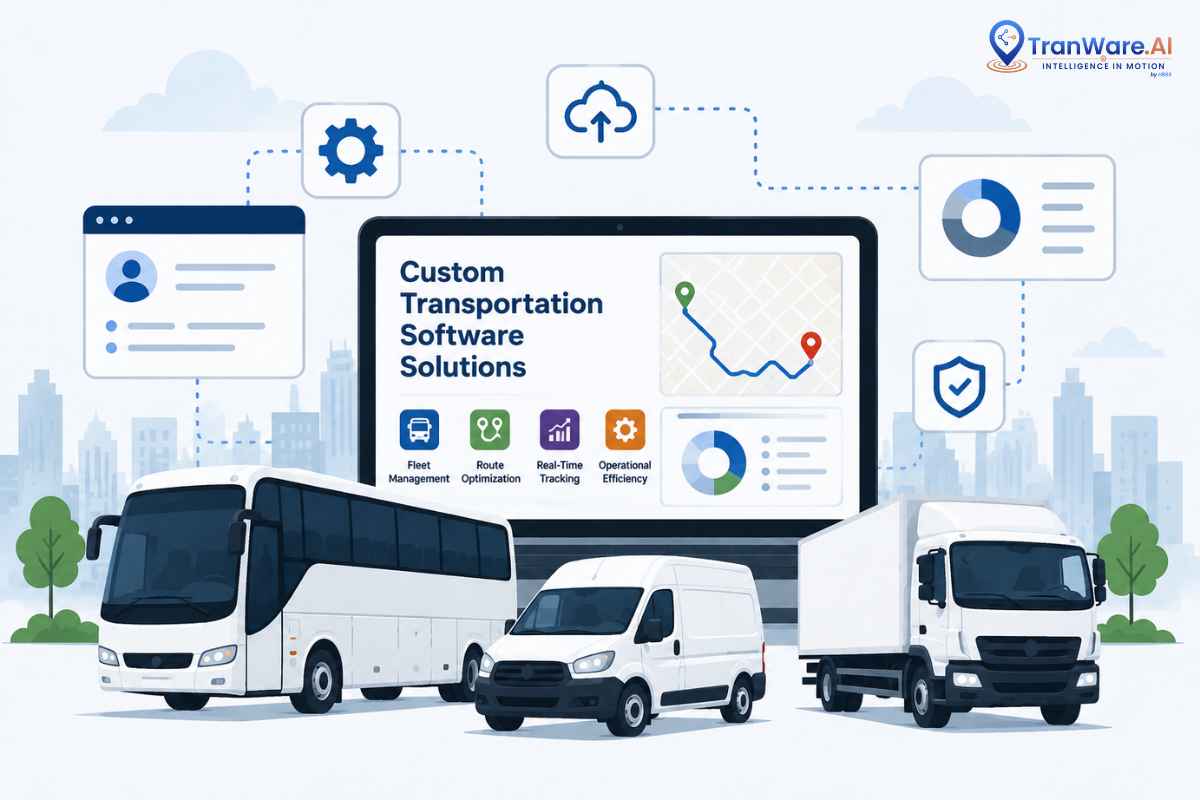
Custom Transportation Software Solutions from TranWare AI are transportation platforms, modules, and integrations tailored to a company’s specific operational needs. Instead of forcing transportation providers to adapt to a rigid system, TranWare AI provides flexible solutions that can be configured to support unique workflows, fleet requirements, and business processes.
Custom transportation software solutions can include:
- Transportation API Integration
- Custom dispatch and scheduling
- Fleet management tools
- NEMT software solutions
- Automated reporting
- Incident Reporting Software
- Trip import and export
- Driver and vehicle management
- Payment and billing integrations
Unlike one-size-fits-all software, TranWare AI can help transportation providers connect existing systems, automate manual processes, and adapt workflows to their unique business requirements. Its custom solutions include API integrations, trip import and export tools, customized reporting, and other configurable modules designed to support different transportation operations.
For NEMT, paratransit, public transit, microtransit, and mixed-use fleets, TranWare AI brings customizable transportation management capabilities together with AI-powered scheduling, dispatching, vehicle tracking, and other operational tools.
Why Businesses Need Custom Transportation Software Solutions
Transportation operations rarely follow the same process from one organization to another. One company may focus on NEMT scheduling, while another manages paratransit, public transit, or a mixed fleet.
Custom technology can help address these differences.
Key Benefits
- Better system integration: Connect transportation platforms with external systems through APIs.
- Less manual data entry: Automate repetitive import, export, and administrative tasks.
- Improved dispatching: Build workflows around specific scheduling and dispatch requirements.
- Greater visibility: Combine vehicle, driver, trip, and customer data.
- Flexible reporting: Create reports based on business-specific fields and metrics.
- Scalable operations: Add functionality as fleet and trip volumes increase.
- Better customer service: Automate notifications, confirmations, reminders, and status updates.
- Reduced operational errors: Standardize processes and minimize repetitive manual work.
Transportation API Integration for Connected Operations
Transportation API Integration allows different software systems to exchange information automatically.
Instead of employees downloading information from one system and manually entering it into another, an API can transfer data between platforms.
Common API Use Cases
A transportation company may use APIs to:
- Receive scheduled trips from a broker.
- Create or update trips automatically.
- Cancel trips when required.
- Send real-time trip status updates.
- Share vehicle or driver information.
- Transfer billing or completed-trip data.
- Connect GPS and tracking platforms.
- Integrate customer-facing applications.
For NEMT operators, API integration can be particularly valuable when working with multiple brokers, healthcare organizations, payment platforms, or other transportation systems.
Custom Fleet Management Software
Custom Fleet Management Software can be configured around the size, vehicle types, maintenance requirements, and operating procedures of a transportation organization.
A basic fleet system may track vehicles, while a more comprehensive solution can connect vehicle information with dispatch, maintenance, inspections, GPS, incidents, and driver activity.
Important Fleet Capabilities
A custom fleet platform may include:
- Vehicle profiles
- Preventive maintenance schedules
- Digital vehicle inspections
- Mileage tracking
- Repair history
- Driver assignments
- GPS integration
- Camera integration
- Incident tracking
- Maintenance alerts
- Fleet performance reports
For example, if a vehicle fails an inspection, the system can flag the issue for maintenance and prevent the vehicle from being assigned until the problem is addressed.
Transportation Management Software Solutions
Transportation Management Software Solutions bring multiple operational functions into one connected environment.
Instead of managing scheduling, dispatching, billing, fleet maintenance, tracking, and reporting through separate tools, organizations can integrate these processes.
A transportation management platform may connect:
Customer → Trip → Scheduler → Dispatcher → Driver → Vehicle → Billing → Reporting
This connected workflow provides better visibility and can reduce duplicate data entry.
Transportation Automation Solutions
Transportation Automation Solutions focus on reducing repetitive tasks that traditionally require staff intervention.
Examples include:
- Automated trip imports
- Automated trip updates
- Automatic customer notifications
- Driver alerts
- Automated reporting
- Digital inspections
- Payment processing
- Automated call handling
- Billing workflows
- Trip status synchronization
Automation does not necessarily mean removing people from the process. Instead, it allows employees to spend more time on exceptions, customer service, and decisions that require human judgment.
Custom Dispatch Software for NEMT Operations
Custom Dispatch Software can be especially useful for organizations with complex transportation requirements.
For NEMT providers, dispatchers may need to coordinate:
- Pickup and drop-off locations
- Appointment times
- Passenger requirements
- Vehicle availability
- Driver availability
- Recurring trips
- Cancellations
- No-shows
- Trip status
- Route changes
A customized NEMT dispatch software solution can organize these processes in a way that matches the provider’s operational model.
Example
Imagine an NEMT company handling 500 trips per day.
If trip information arrives through three different sources, dispatchers may need to manually combine the information before assigning vehicles. An integrated system can automate much of this process, allowing staff to focus on exceptions and last-minute changes.
NEMT Software Solutions for Specialized Transportation
NEMT software solutions are designed to support non-emergency medical transportation providers and their unique scheduling and operational requirements.
Important capabilities can include:
- Trip scheduling
- Dispatching
- Route optimization
- Passenger management
- Driver management
- Vehicle tracking
- Billing
- Payment processing
- Trip status management
- Customer notifications
- Reporting
- Broker integrations
The best NEMT software is not simply the platform with the largest feature list. It should fit the organization’s workflow and integrate effectively with the systems it already uses.
Incident Reporting Software
Incident Reporting Software helps transportation organizations record, manage, and analyze operational incidents.
An incident could involve:
- Vehicle damage
- Passenger complaints
- Driver-related events
- Accidents
- Service delays
- Safety concerns
- Missed pickups
- Other operational issues
A centralized incident system makes it easier to record what happened, when it happened, who was involved, and what action was taken.
Over time, this information can also help transportation managers identify recurring problems and improve operational procedures.
Data and Cost Considerations
Custom software pricing varies widely because the scope of customization is different for every organization. A simple API integration is very different from building an entire transportation management platform.
| Customization Area | Typical Complexity | Main Consideration |
| Basic configuration | Low | Existing system capabilities |
| Custom reports | Low–Medium | Required fields and formats |
| Trip importer/exporter | Medium | Data format and validation |
| API integration | Medium–High | Number and complexity of systems |
| Custom dispatch workflows | High | Scheduling and operational rules |
| Fleet integrations | Medium–High | GPS, cameras, maintenance systems |
| Full custom platform | High | Features, users, integrations, scale |
These are complexity levels, not fixed market prices. A provider should assess the organization’s workflows and integration requirements before giving a project estimate.
Custom Solutions vs. Standard Transportation Software
Choosing between standard and custom transportation software depends on your operational needs, workflow complexity, and long-term growth goals. While standard solutions offer predefined features and faster implementation, custom transportation software provides greater flexibility, tailored workflows, custom integrations, and scalability. The comparison below highlights the key differences to help transportation businesses choose the right approach.
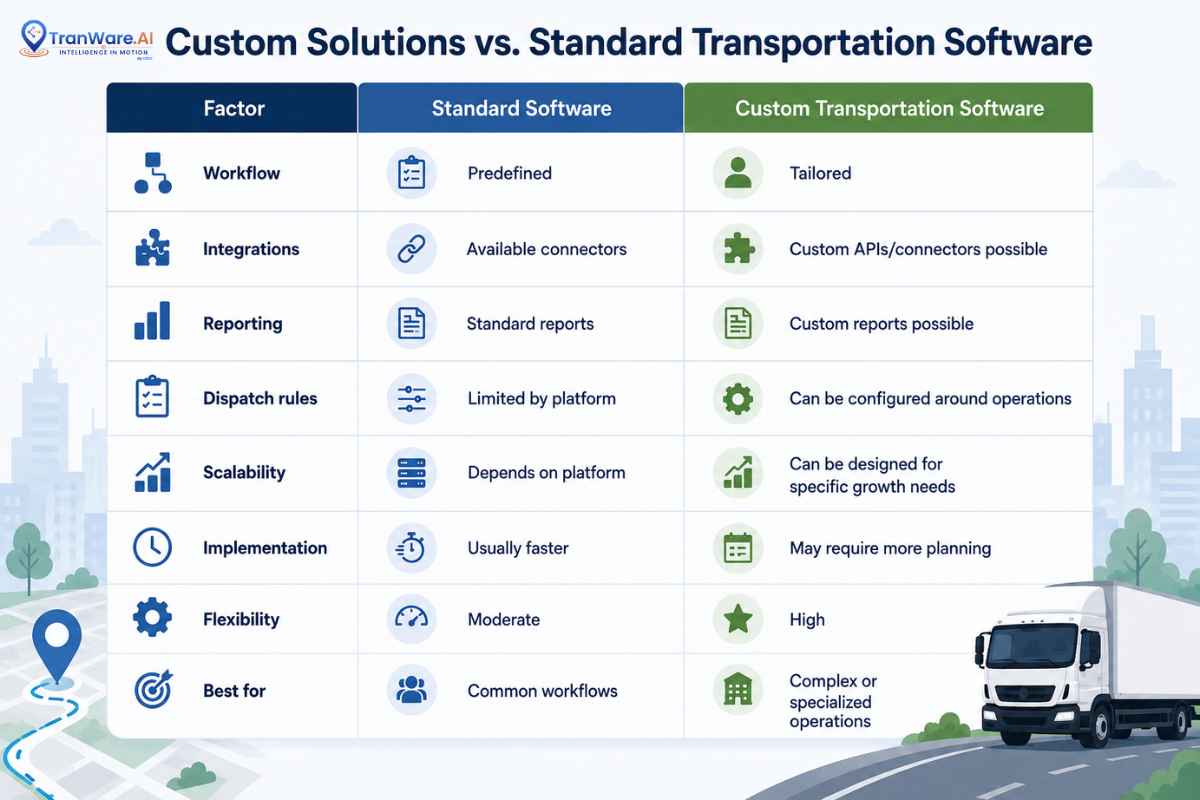
Custom does not always mean completely building software from scratch. In many cases, the better approach is to use an established transportation platform and customize the areas where the business has unique requirements.
How to Choose the Right Custom Transportation Software
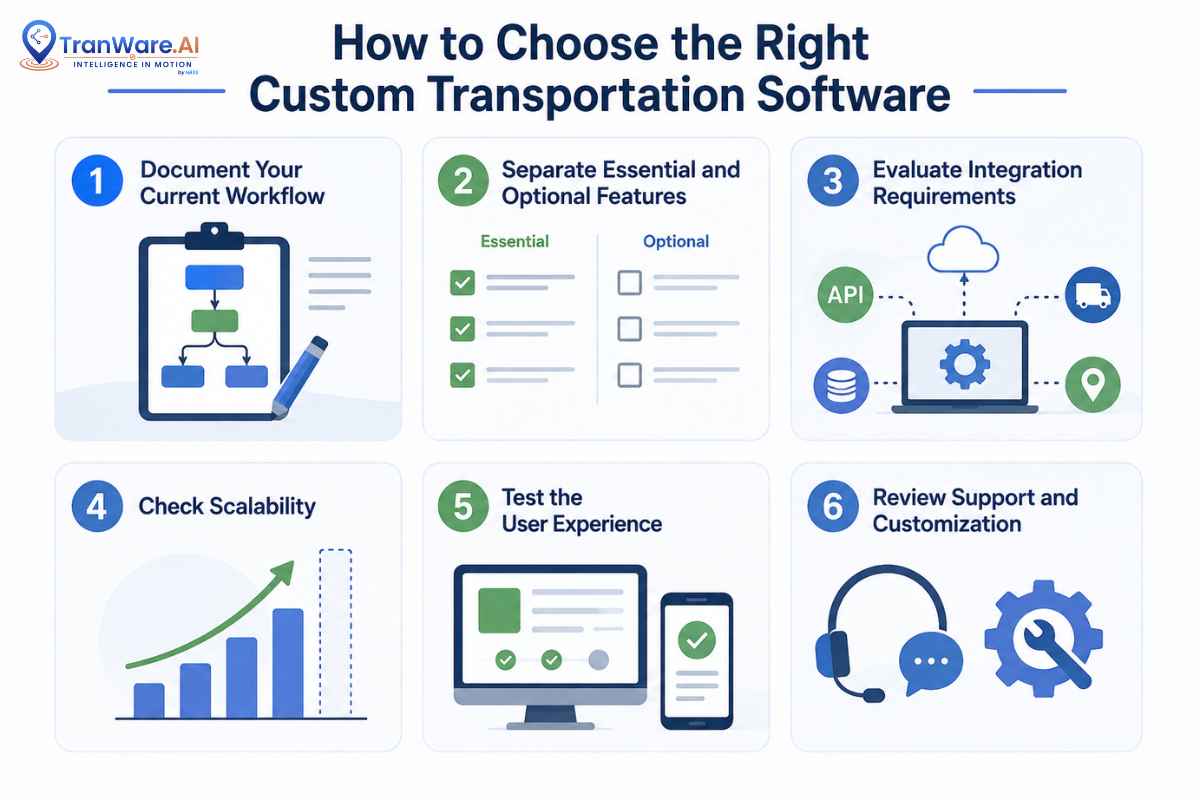
1. Document Your Current Workflow
Start by mapping how trips, customers, drivers, vehicles, payments, and reports move through your organization.
Identify:
- Manual tasks
- Duplicate data entry
- Integration gaps
- Reporting problems
- Dispatch challenges
- Customer service issues
2. Separate Essential and Optional Features
Create two lists:
Essential
- API integration
- Scheduling
- Dispatching
- Fleet management
- Reporting
Optional
- Advanced automation
- Additional integrations
- Custom dashboards
- Specialized notifications
This keeps the project focused.
3. Evaluate Integration Requirements
Ask whether the provider can integrate with:
- Transportation brokers
- Payment systems
- GPS platforms
- Camera systems
- Accounting software
- Customer applications
- Existing databases
4. Check Scalability
Consider future requirements rather than only today’s needs.
Ask:
- Can the system support additional vehicles?
- Can it handle higher trip volumes?
- Can new users be added easily?
- Can additional integrations be introduced?
- Can workflows change as the business grows?
5. Test the User Experience
Software should be practical for dispatchers, drivers, managers, and administrative teams.
Request demonstrations using real operational scenarios rather than generic feature presentations.
6. Review Support and Customization
Customization is an ongoing process in many transportation environments. Confirm how the provider handles:
- Technical support
- System updates
- Integration maintenance
- New reports
- Workflow changes
- Security updates
Key Requirements to Look For
When evaluating Custom Transportation Software Solutions, consider these factors:
- Integration capability: Can the platform connect with your existing systems?
- Customization: Can workflows and reports be adapted?
- Automation: Can repetitive processes be automated?
- Scalability: Can the platform support future growth?
- Security: Are business and customer data protected?
- Mobile access: Can drivers and field employees use the system effectively?
- Reporting: Can managers access the information they actually need?
- Real-time visibility: Can operations teams monitor trips and vehicles?
- Support: Is technical assistance available when required?
- Industry experience: Does the provider understand transportation operations?
Common Mistakes to Avoid
1. Choosing Software Based Only on Features
A long feature list does not guarantee a good operational fit.
2. Ignoring Integrations
A system that cannot communicate with your existing platforms may create more manual work.
3. Customizing Everything
Not every process needs customization. Use standard functionality where it works and customize only where it adds real value.
4. Failing to Involve End Users
Dispatchers, drivers, fleet managers, and billing teams understand operational problems that may not appear in management reports.
5. Forgetting Future Growth
A solution should be able to evolve as fleet size, trip volume, customers, and integrations increase.
Expert Tips for Implementing Custom Transportation Software
- Start with the biggest operational bottleneck.
- Prioritize integrations that eliminate manual data entry.
- Use real workflows during software demonstrations.
- Build reports around decisions managers actually make.
- Test integrations before full deployment.
- Train employees by role rather than giving everyone the same training.
- Track measurable improvements after implementation.
- Review the system regularly as operational needs change.
A useful way to measure success is to compare performance before and after implementation. For example, organizations can track manual data-entry hours, dispatch processing time, trip errors, missed pickups, billing delays, and report preparation time.
Best NEMT Software for Dispatch and Route Optimization
The best NEMT software for dispatch and route optimization should combine scheduling, dispatching, routing, vehicle visibility, driver management, and reporting instead of treating each function as a separate process.
For a growing NEMT provider, an integrated platform can make it easier to coordinate trips while maintaining visibility across vehicles and drivers.
The right solution depends on factors such as fleet size, daily trip volume, broker relationships, geographic coverage, staffing, existing technology, and integration requirements.
Conclusion
Custom Transportation Software Solutions give transportation organizations the flexibility to build technology around their operations. From Transportation API Integration and Custom Fleet Management Software to NEMT dispatching, automation, reporting, and Incident Reporting Software, customization can address gaps that standard systems may not handle effectively.
The strongest approach is not to customize everything. Instead, identify the processes that create the most manual work or operational friction, integrate the systems that need to communicate, and build custom functionality where it delivers measurable value.
For transportation providers evaluating a flexible platform, TranWare AI offers transportation management capabilities for NEMT, paratransit, public transit, microtransit, and mixed-use fleet operations, including scheduling and dispatching, route optimization, fleet maintenance, vehicle tracking, payment processing, reporting, and custom solutions.
Frequently Asked Questions
1. What are Custom Transportation Software Solutions?
They are transportation software platforms, modules, or integrations tailored to an organization’s specific workflows, data requirements, and operational needs.
2. Why is Transportation API Integration important?
It allows different software systems to exchange transportation data automatically, reducing manual data entry and improving information flow.
3. What is Custom Fleet Management Software?
It is fleet software adapted to an organization’s vehicle management, maintenance, inspection, tracking, reporting, and operational requirements.
4. Is custom software useful for NEMT providers?
Yes. NEMT providers often have specialized scheduling, dispatching, broker integration, passenger, billing, and reporting requirements that benefit from configurable technology.
5. What should NEMT software include?
Important capabilities include scheduling, dispatching, route optimization, vehicle tracking, driver management, billing, reporting, notifications, and system integrations.
Interesting Reads:
Transportation Payment Processing Software for NEMT, Fleet and Transit Management
NEMT Dispatch Software for Smarter Scheduling, Dispatching and Fleet Management