
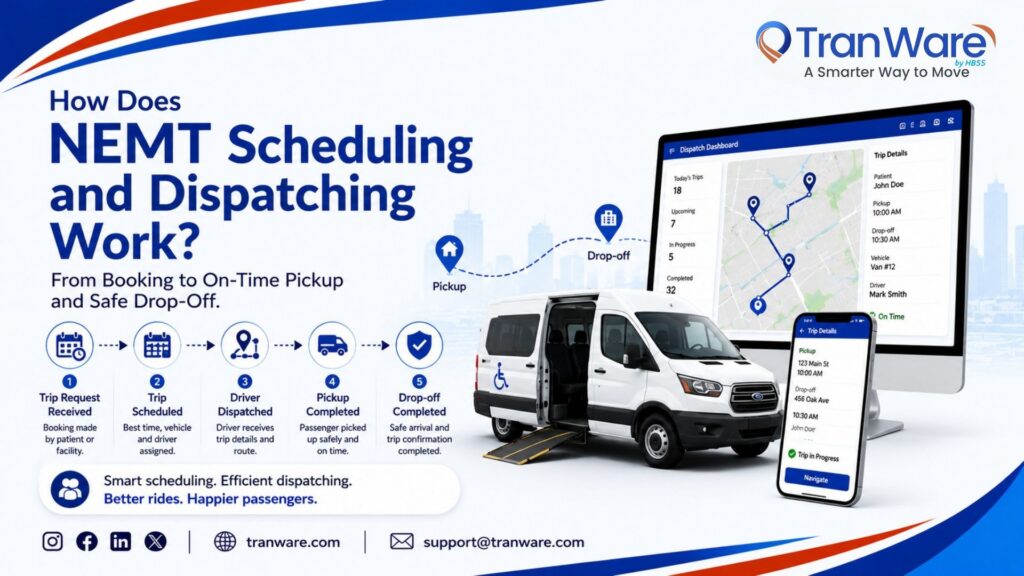
If you’re new to the NEMT industry, one of the first things you’ll need to understand is how trips are scheduled and managed.
Without a proper system, scheduling and dispatching can quickly become confusing and inefficient.
This guide breaks down NEMT scheduling and dispatching in a simple way so you can understand how the entire process works.
Quick Answer: How Does NEMT Scheduling and Dispatching Work?
NEMT scheduling and dispatching work by:
- Booking patient trips in advance
- Assigning drivers based on availability
- Optimizing routes for efficiency
- Dispatching trips in real time
- Tracking trips until completion
Modern systems automate this entire workflow to reduce errors and improve efficiency.
What is NEMT Scheduling?
NEMT scheduling is the process of:
- Booking transportation for patients
- Assigning pickup and drop-off times
- Managing trip details
It ensures that every ride is planned correctly before dispatching.
What is NEMT Dispatching?
Dispatching is the next step after scheduling.
It involves:
- Assigning trips to drivers
- Sending trip details
- Monitoring trips in real time
Together, scheduling and dispatching form the core transport workflow in NEMT operations.
Step-by-Step NEMT Scheduling and Dispatch Process
Step 1: Trip Booking
Trips are scheduled based on:
- Patient requests
- Appointment times
- Pickup and drop-off locations
This can be done manually or through a trip scheduling system.
Step 2: Trip Assignment
Once booked, trips are assigned to drivers based on:
- Availability
- Location
- Vehicle type
Automated systems make this process faster and more accurate.
Step 3: Route Planning
Routes are planned to:
- Minimize travel time
- Reduce fuel costs
- Ensure timely pickups
This is where efficiency begins.
Step 4: Dispatching Trips
Dispatchers send trip details to drivers:
- Pickup time
- Location
- Passenger details
This step ensures drivers know exactly what to do.
Step 5: Real-Time Monitoring
During the trip:
- Dispatchers track vehicle location
- Monitor delays
- Make adjustments if needed
This improves coordination and reduces missed trips.
Step 6: Trip Completion & Recording
After completion:
- Trip data is recorded
- Billing is generated
- Performance is tracked
This closes the loop in the dispatch process in NEMT.
Data & Example: Workflow Efficiency
Here’s how NEMT scheduling systems improve operations:
| Metric | Manual Process | Automated System |
|---|---|---|
| Scheduling Time | Slow | Fast |
| Dispatch Accuracy | Low | High |
| Missed Trips | Frequent | Reduced |
| Operational Visibility | Limited | Full |
A new NEMT operator in the USA reduced scheduling time by 60% after implementing an automated scheduling system.
Benefits of Automated NEMT Scheduling and Dispatching
- Improved Efficiency
Automation reduces manual work and speeds up operations.
- Fewer Errors
Accurate scheduling reduces missed or incorrect trips.
- Better Coordination
Drivers and dispatchers stay connected in real time.
- Higher Customer Satisfaction
Timely pickups improve service quality and reliability.
Practical Tips for New Operators
- Use Software Instead of Manual Scheduling: Automation improves accuracy and operational efficiency.
- Start with Simple Workflows: Build efficient processes first, then scale gradually as your business grows.
- Monitor Trips in Real Time; Live tracking helps identify delays and operational issues quickly.
- Train Your Dispatch Team Properly: Well-trained teams improve communication and dispatch accuracy.
- Analyze Operational Data Regularly: Performance analysis helps improve workflows and reduce inefficiencies.
Common Mistakes to Avoid
- Relying on Manual Scheduling Methods: Manual systems increase delays, confusion, and operational inefficiencies.
- Not Using Route Optimization: Poor routing increases travel time and fuel expenses.
- Poor Communication with Drivers: Communication gaps can lead to delays and missed trips.
- Ignoring Real-Time Tracking: Without visibility, managing operations becomes difficult.
- Overcomplicating Workflows: Simple and streamlined processes improve efficiency and scalability.
FAQs About NEMT Scheduling and Dispatching
1. What is NEMT scheduling?
It is the process of booking and organizing patient transportation trips.
2. What is dispatching in NEMT?
It involves assigning trips to drivers and managing them in real time.
3. Can scheduling and dispatching be automated?
Yes, modern systems automate both processes.
4. How does automation help?
It reduces errors, improves efficiency, and saves time.
5. Is scheduling software necessary?
Yes, it is essential for managing operations effectively.
6. Can I track trips in real time?
Yes, most systems provide real-time tracking features.
Conclusion
Understanding how NEMT scheduling and dispatching work is essential for running a successful transportation business.
With the right system, you can:
- Automate workflows
- Reduce errors
- Improve efficiency
- Deliver better service
For new operators in the USA, adopting modern scheduling and dispatch tools is key to long-term success.
Ready to Streamline Your NEMT Operations?
Start using a reliable scheduling and dispatch solution that helps automate workflows, improve coordination, and reduce operational inefficiencies.
The right platform can help your transportation business operate more efficiently, improve service quality, and scale with confidence. Visit at – TranWare
Interesting Reads:
What Features Should You Look for in NEMT Software? (Expert Guide)
How to Start a NEMT Business in the USA: Complete Step-by-Step Guide